
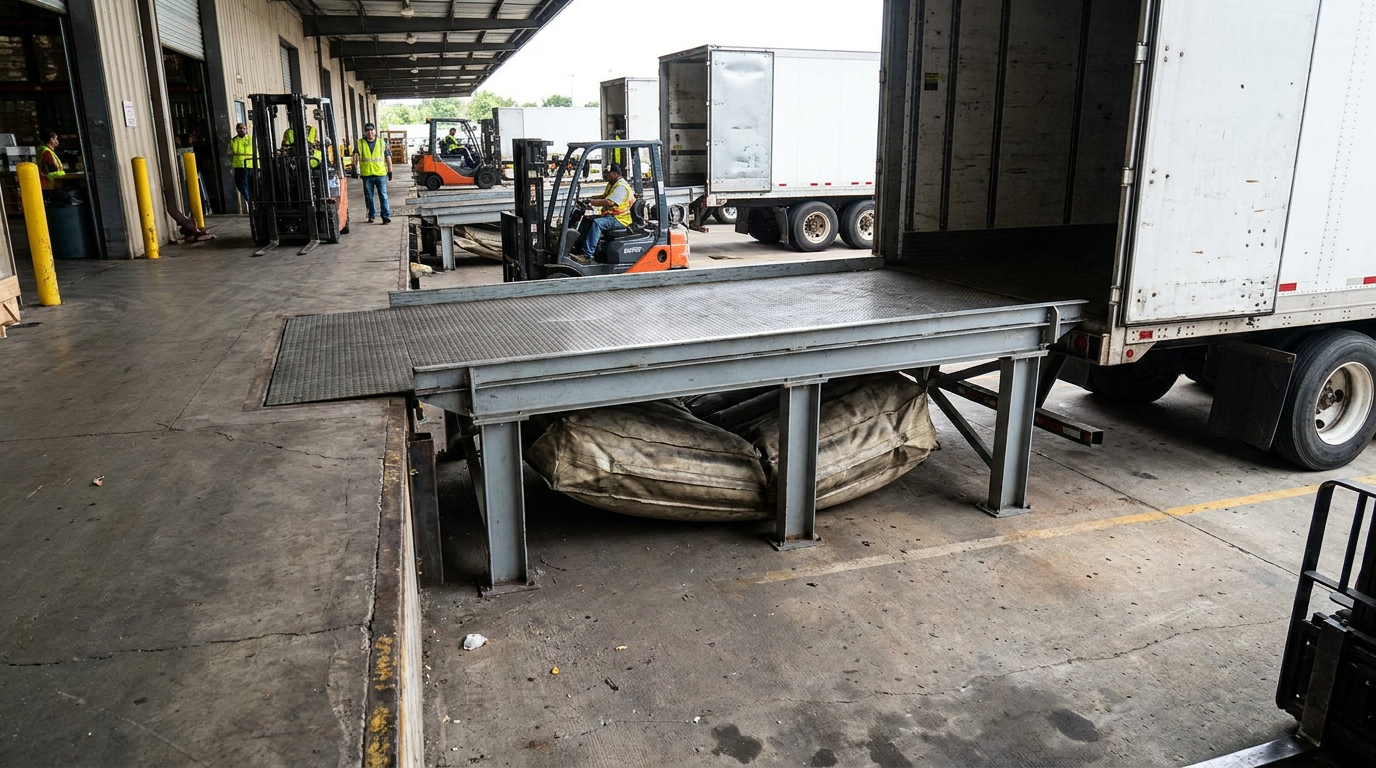
Air-powered dock levelers are an efficient, low-maintenance loading dock solution that uses an airbag lifting system to bridge the height gap between a facility floor and a trailer bed. For warehouse managers, plant engineers, maintenance supervisors, safety managers, and purchasing professionals, understanding how air-powered dock levelers work—and where they fit compared with hydraulic dock levelers, mechanical dock levelers, dock plates, and dock boards—can help improve loading dock safety, productivity, and long-term operating costs.
Loading docks are among the busiest and highest-risk areas in many facilities. Every pallet moved across the dock involves people, forklifts, pallet jacks, trailers, overhead doors, dock bumpers, dock seals, vehicle restraints, and other material handling equipment working together. A properly selected and maintained air-powered dock leveler can reduce manual effort, improve ergonomics, minimize equipment wear, and help create a safer, more consistent loading process.
An air-powered dock leveler is a fixed loading dock device installed in a pit at the dock door. Its purpose is to create a smooth transition between the warehouse floor and a truck or trailer bed, allowing forklifts, pallet jacks, and other material handling equipment to move freight in and out safely.
Unlike mechanical dock levelers that use springs and manual pull chains, or hydraulic dock levelers that use hydraulic cylinders and pumps, air-powered dock levelers use an airbag system. When activated, an electric blower inflates a heavy-duty airbag beneath the leveler platform. As the airbag expands, it raises the deck. The lip then extends onto the trailer bed, and the leveler lowers into working position.
Key Components of an Air-Powered Dock Leveler
Most air-powered dock levelers include the following components:
- Deck/platform: The main steel surface that supports forklift and pallet traffic.
- Lip: The hinged extension that rests on the trailer bed.
- Airbag lifting system: Inflatable lifting bag that raises the deck.
- Blower motor: Supplies air to inflate the bag.
- Push-button controls: Allow operators to raise and position the leveler.
- Hinge assembly: Connects the lip to the deck and allows smooth operation.
- Safety legs or support system: Helps support the deck in certain situations.
- Toe guards and side guards: Help reduce pinch-point hazards.
- Dock pit frame: Steel frame installed into the concrete pit.
- Maintenance strut: Supports the deck during inspection or service.
Air-powered dock levelers are often chosen as a middle ground between mechanical and hydraulic models. They offer push-button operation without the hydraulic fluid concerns associated with hydraulic systems.
For those interested in understanding the intricacies of air-powered dock levelers, a related article that provides valuable insights on selecting the appropriate material handling equipment can be found at Choose the Right Material Handling Equipment. This article complements the discussion on dock levelers by exploring various types of equipment that enhance efficiency and safety in loading and unloading operations.
How Air-Powered Dock Levelers Work
Air-powered dock levelers operate through a simple but effective lifting process. The operator typically uses a control panel mounted near the dock door.
Standard Operating Sequence
A typical operating cycle works as follows:
- Trailer backs into the dock.
The trailer contacts the dock bumpers, and the truck is secured with wheel chocks or, preferably, a vehicle restraint.
- Dock door opens.
The operator confirms that the trailer is properly positioned and secured.
- Operator presses the control button.
The blower motor activates and inflates the airbag under the leveler deck.
- Deck rises.
As the airbag expands, the platform lifts above the trailer bed height.
- Lip extends.
The lip swings outward as the deck reaches the correct height.
- Deck lowers onto the trailer.
The operator releases the control, the airbag deflates, and the lip rests securely on the trailer floor.
- Loading or unloading begins.
Forklifts and pallet jacks travel across the dock leveler into the trailer.
- Leveler returns to stored position.
After loading is complete, the operator raises the deck, lets the lip retract, and returns the leveler to the dock floor.
What Makes Air-Powered Operation Different?
The primary difference is the lifting mechanism. Air-powered dock levelers use air pressure instead of hydraulic pressure or spring force.
This provides several operational advantages:
- Push-button activation
- No manual pull-chain effort
- No hydraulic oil leaks
- Fewer high-pressure components
- Lower physical strain on employees
- Reliable operation in many standard dock environments
However, air-powered dock levelers still require electricity to run the blower motor, and their performance depends on the condition of the airbag, blower, electrical controls, and mechanical hinges.
Common Applications for Air-Powered Dock Levelers
Air-powered dock levelers are used in a wide range of warehouses, distribution centers, manufacturing plants, food facilities, retail logistics operations, and industrial buildings.
Warehousing and Distribution
In warehouse and distribution environments, air-powered dock levelers support frequent loading and unloading of palletized goods. They are well suited for facilities that need push-button operation but want to avoid hydraulic fluid maintenance.
Common uses include:
- General freight distribution
- E-commerce fulfillment
- Grocery and beverage distribution
- Consumer goods warehousing
- Third-party logistics operations
Manufacturing and Plant Operations
Manufacturing facilities often use air-powered dock levelers to move inbound raw materials and outbound finished products. Plant engineers may prefer them in areas where simple mechanical design and cleaner operation are priorities.
Typical applications include:
- Packaging plants
- Automotive suppliers
- Light manufacturing
- Industrial component production
- Paper and printing facilities
Food, Beverage, and Clean Environments
Air-powered dock levelers may be attractive in facilities where hydraulic fluid leakage is a concern. While not all air-powered models are designed specifically for washdown or sanitary environments, eliminating hydraulic oil from the lifting system can be beneficial.
Potential applications include:
- Food processing plants
- Cold storage facilities
- Beverage distribution centers
- Pharmaceutical packaging operations
- Clean manufacturing areas
For temperature-controlled buildings, air-powered dock levelers are often paired with dock seals, dock shelters, insulated doors, and trailer restraints to improve energy efficiency and environmental control.
Please visit this dock equipment guide for more information.
Benefits of Air-Powered Dock Levelers
Air-powered dock levelers offer a strong combination of operational efficiency, safety, and maintenance advantages.
Push-Button Operation
One of the most noticeable benefits is ease of use. Operators do not need to bend, pull a chain, or fight spring tension as they would with many mechanical dock levelers.
This can help:
- Reduce operator fatigue
- Improve dock efficiency
- Support ergonomic safety goals
- Encourage consistent dock leveler use
- Reduce the risk of improper manual operation
No Hydraulic Fluid
Because air-powered dock levelers use an airbag rather than hydraulic cylinders, they eliminate the risk of hydraulic oil leaks from the lifting system.
This is especially useful in facilities where leaks could create:
- Slip hazards
- Product contamination risks
- Environmental cleanup issues
- Maintenance downtime
- Damage to concrete floors or dock pits
Lower Maintenance Than Some Alternatives
Air-powered dock levelers typically have fewer complex moving parts than mechanical spring systems and do not require hydraulic fluid changes, hose inspections, or cylinder seal replacement.
Maintenance is still required, but many facilities find air-powered units easier to maintain than heavily used mechanical levelers.
Reliable Performance for Standard Dock Operations
For many standard loading dock applications, air-powered dock levelers provide consistent performance and long service life when properly specified and maintained.
They work well for:
- Moderate to high dock traffic
- Palletized loads
- Forklift traffic
- General freight trailers
- Facilities needing powered operation without hydraulics
Improved Loading Dock Safety
When used correctly and paired with other loading dock safety equipment, air-powered dock levelers can reduce trip hazards, impact shock, and unsafe height transitions.
They can be integrated with:
- Vehicle restraints
- Dock lights
- Dock bumpers
- Dock seals
- Dock shelters
- Communication lights
- Overhead door interlocks
- Trailer stands where needed
A dock leveler alone does not make a dock safe, but it is a critical part of the overall loading dock safety system.
For those interested in optimizing their loading dock operations, a related article on the benefits of air-powered dock levelers can provide valuable insights. You can explore this topic further in the article found here, which discusses how these innovative systems enhance efficiency and safety in various industrial settings. Understanding the advantages of air-powered solutions can help businesses make informed decisions about their loading dock equipment.
Limitations of Air-Powered Dock Levelers
| Feature | Advantages |
|---|---|
| Easy Operation | Simple push-button operation for raising and lowering the leveler |
| Enhanced Safety | Air-powered systems provide smooth and controlled movement, reducing the risk of accidents |
| Low Maintenance | Minimal moving parts and no hydraulic fluid to monitor |
| Energy Efficiency | Uses less energy compared to hydraulic systems |
Air-powered dock levelers are versatile, but they are not ideal for every application. Purchasing professionals and facility teams should understand their limitations before selecting a model.
Requires Electrical Power
The blower motor requires electricity. In the event of a power outage, operation may be limited unless backup procedures or alternative equipment are available.
Facilities with unreliable power may need to consider:
- Backup generators
- Manual override options
- Dock plates or dock boards for emergency use
- Hydraulic or mechanical alternatives depending on the application
Airbag Wear Over Time
The airbag is a durable component, but it is still subject to wear, puncture, cracking, or environmental damage. Regular inspection is important to ensure safe operation.
Potential causes of airbag damage include:
- Debris in the dock pit
- Sharp metal edges
- Chemical exposure
- Improper maintenance
- Age-related material fatigue
Not Always Best for Extreme Heavy-Duty Use
Air-powered dock levelers are available in various capacities, but extremely heavy applications may be better served by heavy-duty hydraulic dock levelers or specialty equipment.
Examples include:
- Steel handling
- Heavy paper rolls
- High-cycle forklift traffic
- Very heavy concentrated loads
- Large industrial lift trucks
- Non-standard trailers or container handling
Environmental Considerations
Dock pits can collect water, debris, ice, snow, and contaminants. Air-powered units should be selected and maintained with the facility environment in mind.
Cold storage, outdoor exposure, corrosive environments, and washdown areas may require special options, seals, coatings, or maintenance practices.
For those interested in optimizing their loading and unloading processes, a deeper understanding of air-powered dock levelers can be beneficial. You might find it helpful to explore a related article that discusses the advantages and features of these systems in detail. This resource can provide valuable insights into how air-powered dock levelers can enhance efficiency and safety in your operations. To learn more, check out this informative piece on dock levelers.
Air-Powered Dock Levelers vs. Other Dock Equipment
Choosing the right loading dock equipment depends on load weight, traffic frequency, trailer types, budget, safety requirements, and maintenance capabilities.
Comparison Table
| Equipment Type | Best For | Advantages | Limitations |
|||||
| Air-powered dock levelers | Standard dock operations needing powered operation | Push-button use, no hydraulic fluid, moderate maintenance | Requires electricity, airbag inspection needed |
| Hydraulic dock levelers | High-cycle or heavy-duty applications | Strong, smooth operation, many safety options | Hydraulic fluid leaks possible, higher initial cost |
| Mechanical dock levelers | Budget-conscious facilities | No electrical power required, lower upfront cost | Manual effort, spring maintenance, ergonomic concerns |
| Dock plates | Light-duty hand truck or pallet jack use | Portable, simple, lower cost | Not for powered forklifts unless rated; limited capacity |
| Dock boards | Portable forklift access | Higher capacity than dock plates, side curbs | Manual placement, storage needed |
| Edge-of-dock levelers | Limited space, lower height differences | Compact, lower cost than pit levelers | Limited service range and capacity |
| Vertical storing levelers | Cold storage, sanitary facilities | Better environmental control, easy pit cleaning | Higher cost, specialized installation |
Dock Levelers vs. Dock Plates and Dock Boards
Dock plates and dock boards are portable bridging devices, while air-powered dock levelers are fixed, pit-mounted systems.
- Dock plates are generally used for lighter loads, hand trucks, and pallet jacks.
- Dock boards are heavier-duty portable devices often used for forklift traffic.
- Dock levelers are more efficient for regular trailer loading at permanent dock positions.
For busy loading docks, an air-powered dock leveler is often safer and more productive than repeatedly placing and removing portable dock boards.
Safety Considerations for Air-Powered Dock Levelers
Loading dock safety requires a complete system approach. Air-powered dock levelers should be used with proper procedures, employee training, inspections, and compatible safety equipment.
Major Loading Dock Hazards
Common hazards include:
- Trailer creep or separation
- Early truck departure
- Forklift run-off
- Falls from open dock doors
- Pinch points
- Slips and trips
- Poor lighting
- Damaged dock levelers
- Unsupported trailer landing gear
- Wet, icy, or debris-filled dock areas
Vehicle Restraints and Trailer Security
One of the most important safety practices is securing the trailer before loading begins. A trailer can move away from the dock due to forklift impact, suspension movement, or driver error.
Vehicle restraints help prevent:
- Premature trailer departure
- Trailer creep
- Dock leveler lip losing support
- Forklift accidents at the dock edge
At minimum, wheel chocks should be used where appropriate. However, many modern facilities use automatic or manual vehicle restraints with inside/outside communication lights for improved control.
Dock Bumpers, Dock Seals, and Dock Shelters
Air-powered dock levelers work best as part of a complete dock system.
- Dock bumpers protect the building, dock leveler, and trailer from impact damage.
- Dock seals compress around the trailer opening to reduce air infiltration.
- Dock shelters provide a larger, flexible enclosure around the trailer.
- Dock lights improve visibility inside trailers.
- Communication lights help coordinate drivers and dock personnel.
These related components improve safety, energy efficiency, product protection, and building longevity.
OSHA and ANSI Best Practices
OSHA does not have a single regulation dedicated only to air-powered dock levelers, but several OSHA requirements and recognized industry best practices apply to loading dock safety, powered industrial trucks, walking-working surfaces, and hazard communication.
ANSI standards, particularly those related to loading dock equipment, also help guide safer design, installation, inspection, and use.
OSHA Considerations
Relevant OSHA topics may include:
- Powered industrial truck safety: Forklift operators must be trained and evaluated.
- Walking-working surfaces: Employers must address fall, slip, and trip hazards.
- Machine guarding and pinch points: Equipment should be used and maintained to reduce exposure to moving parts.
- Lockout/tagout: Maintenance personnel must control hazardous energy during service.
- Hazard communication: If chemicals, lubricants, or cleaning products are used, employees need appropriate information and training.
- General duty clause: Employers must provide a workplace free from recognized serious hazards.
Facilities should develop written procedures for loading dock operation, trailer restraint use, dock leveler inspection, and emergency response.
ANSI and Industry Best Practices
ANSI MH30.1 is commonly referenced for dock levelers and related loading dock equipment. While facility teams should consult the current standard and manufacturer instructions, best practices typically include:
- Use dock levelers only within rated capacity.
- Train operators on correct procedures.
- Inspect equipment regularly.
- Keep the dock area clean and dry.
- Use maintenance struts before working under the deck.
- Never operate a damaged dock leveler.
- Keep hands, feet, and tools away from pinch points.
- Confirm the lip has adequate trailer bed contact.
- Do not drive across a leveler unless the trailer is properly secured.
- Use fall protection or barriers at open dock positions when required.
Rated Capacity and Dynamic Loads
A common mistake is assuming a dock leveler’s rated capacity equals the forklift’s load capacity. In reality, dock leveler capacity must account for:
- Forklift weight
- Load weight
- Speed
- Frequency of use
- Grade and impact
- Concentrated wheel loads
- Turning or braking forces
For example, a 5,000-pound forklift carrying a 4,000-pound pallet may impose much more than 9,000 pounds of dynamic stress on the dock leveler. Purchasing teams should consult qualified suppliers to properly size the equipment.
Maintenance Requirements
Air-powered dock levelers are designed for durability, but routine maintenance is essential for safe and reliable performance.
Daily or Shift Inspections
Operators should visually inspect the dock leveler before use. A simple checklist can help catch problems early.
Check for:
- Visible structural damage
- Bent or cracked lip
- Debris in the pit
- Unusual noises
- Proper deck movement
- Lip extension and retraction
- Damaged controls
- Missing safety labels
- Worn dock bumpers
- Trailer restraint function
- Adequate lighting
If anything appears unsafe, the dock position should be taken out of service until inspected by qualified personnel.
Monthly Maintenance
Maintenance supervisors should schedule more detailed inspections based on usage and manufacturer recommendations.
Monthly tasks may include:
- Clean debris from the dock pit.
- Inspect the airbag for wear, cracks, or punctures.
- Check blower operation.
- Inspect electrical wiring and control stations.
- Lubricate hinge points where recommended.
- Inspect welds and structural components.
- Confirm safety legs or supports function properly.
- Check lip hinge pins and keepers.
- Inspect weather seals if installed.
- Verify communication lights and vehicle restraints.
Annual or Periodic Professional Service
At least annually—or more often in high-cycle operations—facilities should consider professional service by experienced loading dock technicians.
Professional inspections may include:
- Full operational testing
- Structural evaluation
- Airbag condition assessment
- Control system inspection
- Lip and hinge alignment
- Pit condition review
- Safety system verification
- Capacity and usage review
- Documentation for compliance programs
A preventive maintenance program can extend equipment life and reduce the risk of costly downtime.
Troubleshooting Air-Powered Dock Levelers
When an air-powered dock leveler does not work properly, the cause may be electrical, mechanical, or related to the air lifting system.
Dock Leveler Will Not Raise
Possible causes include:
- No power to control panel
- Tripped breaker or blown fuse
- Faulty push button
- Failed blower motor
- Damaged wiring
- Torn or disconnected airbag
- Obstruction in the pit
- Mechanical binding
Recommended action:
- Verify power supply.
- Check for obvious obstructions.
- Do not force the leveler.
- Lock out equipment before inspection.
- Contact a qualified technician if the cause is not immediately clear.
Deck Raises Slowly
Possible causes include:
- Weak blower motor
- Airbag leak
- Restricted airflow
- Debris under the deck
- Excessive friction at hinge points
- Electrical voltage issue
A slow-raising leveler may still operate, but it should be inspected before the problem worsens.
Lip Does Not Extend Properly
Possible causes include:
- Lip hinge corrosion
- Broken or worn linkage
- Debris blocking lip movement
- Insufficient deck height
- Bent lip plate
- Damaged hinge pins
Do not use the leveler if the lip does not make proper contact with the trailer bed.
Leveler Does Not Return to Stored Position
Possible causes include:
- Binding hinge
- Damaged return mechanism
- Pit debris
- Lip not retracting
- Structural deformation
- Improper adjustment
A dock leveler left above or below floor level can become a trip hazard and may damage forklifts or loads.
Unusual Noise During Operation
Grinding, squealing, banging, or popping sounds may indicate:
- Worn hinge pins
- Structural cracks
- Loose hardware
- Blower issues
- Debris interference
- Lip impact damage
Operators should report unusual noises immediately.
Buying Factors for Air-Powered Dock Levelers
Selecting the right air-powered dock leveler requires more than comparing prices. The best choice depends on facility conditions, traffic levels, equipment types, safety requirements, and long-term cost of ownership.
Capacity
Capacity is one of the most important specifications. Common rated capacities may range from approximately 25,000 to 45,000 pounds or more, depending on the model and manufacturer.
Consider:
- Heaviest forklift weight
- Maximum load weight
- Number of cycles per day
- Wheel load concentration
- Speed of traffic
- Use of electric pallet jacks or rider trucks
- Future operational changes
When in doubt, choose a higher-capacity model rather than undersizing the dock leveler.
Platform Size
Common pit leveler sizes include widths of 6, 6.5, or 7 feet and lengths of 6, 8, 10, or 12 feet. The correct size depends on trailer heights, forklift gradeability, and load stability.
Longer levelers reduce the slope between dock and trailer, which is important for:
- Low-clearance forklifts
- Tall or unstable loads
- Heavy pallet movement
- Electric pallet jacks
- Dock height variations
Service Range
Service range refers to the height range above and below dock level where the leveler can operate safely. If your facility serves a wide variety of trailers, confirm that the air-powered dock leveler can accommodate them.
Trailer types may include:
- Standard dry vans
- Refrigerated trailers
- Flatbeds
- Intermodal containers
- Step vans
- Low trailers
- High-cube trailers
For extreme height differences, other solutions may be needed.
Construction Quality
Look for durable construction features such as:
- Heavy-duty steel deck
- Structural steel rear frame
- Reinforced lip
- Quality hinge design
- Durable airbag material
- Reliable blower motor
- Corrosion-resistant finishes
- Robust control components
- Full-width rear hinge support
A dock leveler is a long-term capital investment. Strong construction reduces downtime and repair costs.
Safety Options
Important safety-related options may include:
- Integrated vehicle restraint controls
- Interlock with overhead door
- Inside/outside communication lights
- Fall protection barriers
- Deck and lip safety markings
- Weather seals
- Non-skid deck surface
- Night locks or security features
- Automatic return-to-dock functions
Safety managers should review whether the dock leveler will be part of a larger loading dock safety system.
Environmental Conditions
Consider the environment where the leveler will operate:
- Cold storage
- Freezer docks
- Washdown areas
- Corrosive chemicals
- Outdoor exposure
- Heavy dust or debris
- Food-grade requirements
- High humidity
- Coastal locations
Special coatings, weather seals, pit drainage, and upgraded components may be appropriate.
Total Cost of Ownership
The lowest purchase price is not always the best value. Evaluate:
- Installation cost
- Pit modifications
- Electrical requirements
- Maintenance frequency
- Expected service life
- Downtime risk
- Replacement parts availability
- Warranty coverage
- Energy efficiency
- Safety system compatibility
A reliable air-powered dock leveler can deliver long-term savings through reduced maintenance, improved productivity, and fewer safety incidents.
Installation Considerations
Proper installation is critical for performance and safety. Air-powered dock levelers are usually installed in a recessed concrete pit at the loading dock.
New Construction
For new facilities, plant engineers and project managers should coordinate dock design early. Dock height, pit dimensions, trailer approach, drainage, door size, and equipment selection all affect the final system.
New construction planning should include:
- Dock height and trailer fleet analysis
- Pit layout and reinforcement
- Electrical service
- Door and seal compatibility
- Vehicle restraint placement
- Dock bumper selection
- Traffic flow
- Safety signage and lighting
Retrofit Projects
Replacing an older mechanical or hydraulic dock leveler with an air-powered model may be straightforward if the pit dimensions match. However, some retrofits require modification.
Key retrofit questions include:
- Is the existing pit structurally sound?
- Are pit dimensions compatible?
- Is electrical power available?
- Are dock bumpers in good condition?
- Should vehicle restraints be added?
- Are dock seals or shelters worn?
- Does the existing dock height match trailer needs?
A professional site evaluation helps avoid costly surprises.
Common Mistakes to Avoid
Even high-quality air-powered dock levelers can perform poorly if selected, used, or maintained incorrectly.
Undersizing the Leveler
Choosing a dock leveler based only on upfront cost can lead to premature wear, structural damage, and safety risks. Capacity should match real-world dynamic loading conditions.
Ignoring Trailer Restraint Needs
A dock leveler does not secure a trailer. Without vehicle restraints or proper chocking procedures, the trailer can move away from the dock, creating a dangerous gap.
Skipping Maintenance
Air-powered dock levelers are not maintenance-free. Neglecting inspections can allow small issues—such as debris in the pit or worn hinge pins—to become major failures.
Using Damaged Equipment
Operators should never use a dock leveler with a bent lip, cracked weld, malfunctioning controls, or abnormal movement. Damaged equipment should be locked out until repaired.
Poor Operator Training
Even push-button dock levelers require training. Operators must understand:
- Trailer positioning
- Restraint use
- Proper lip placement
- Capacity limits
- Communication lights
- Emergency procedures
- Reporting requirements
Overlooking the Entire Dock System
An air-powered dock leveler works with other dock equipment. Worn dock bumpers, damaged dock seals, poor lighting, and missing restraints can undermine safety and performance.
Best Practices for Daily Operation
A consistent operating procedure helps reduce accidents and equipment damage.
Before Loading or Unloading
Operators should:
- Confirm the trailer is properly positioned.
- Secure the trailer with a vehicle restraint or wheel chocks.
- Inspect the dock leveler for visible damage.
- Verify dock bumpers are intact.
- Open the overhead door safely.
- Check trailer floor condition.
- Ensure dock lights are working.
- Keep pedestrians clear of the dock area.
During Loading
Operators should:
- Drive slowly over the leveler.
- Avoid sudden braking or turning on the deck.
- Keep loads stable and within capacity.
- Watch for trailer movement.
- Stay alert for wet or damaged trailer floors.
- Report unusual noises or movement.
After Loading
Operators should:
- Return the leveler to the stored position.
- Close the dock door if the position is not in use.
- Release the vehicle restraint only when safe.
- Follow communication light procedures.
- Keep the dock area clear of debris.
FAQs About Air-Powered Dock Levelers
Are air-powered dock levelers better than hydraulic dock levelers?
Not always. Air-powered dock levelers are excellent for many standard applications because they offer push-button operation without hydraulic fluid. Hydraulic dock levelers may be better for very heavy-duty, high-cycle, or specialized applications. The best choice depends on load requirements, usage frequency, environment, and maintenance preferences.
How long do air-powered dock levelers last?
With proper selection, installation, and maintenance, an air-powered dock leveler can provide many years of service. Service life depends on traffic volume, load weights, environmental conditions, operator behavior, and preventive maintenance.
Do air-powered dock levelers need compressed air?
No. Most air-powered dock levelers use an electric blower to inflate an airbag. They typically do not require a facility compressed air system.
Can forklifts use air-powered dock levelers?
Yes, air-powered dock levelers are commonly used with forklifts, as long as the unit is properly rated for the combined dynamic load of the forklift, load, and operating conditions.
Are air-powered dock levelers safe?
They can be very safe when properly specified, installed, maintained, and used with correct procedures. Safety also depends on trailer restraints, dock bumpers, dock lighting, operator training, and compliance with OSHA and ANSI best practices.
What maintenance is required?
Routine maintenance includes cleaning the pit, inspecting the airbag, checking the blower and controls, lubricating recommended pivot points, inspecting welds and hinges, and testing safety systems. High-use docks should be inspected more frequently.
What happens if the airbag fails?
If the airbag is damaged or fails, the dock leveler may not raise properly. The equipment should be removed from service and inspected by qualified maintenance personnel or a loading dock technician.
Can an air-powered dock leveler replace a dock board?
In many permanent dock positions, yes. Air-powered dock levelers are more efficient and convenient than portable dock boards for routine loading. However, dock boards may still be useful for temporary, remote, or backup applications.
What capacity do I need?
Capacity depends on forklift weight, load weight, traffic frequency, speed, wheel loads, and impact conditions. A qualified loading dock professional can help determine the appropriate capacity for your operation.
Should I add a vehicle restraint with an air-powered dock leveler?
In many facilities, yes. Vehicle restraints are a key part of loading dock safety because they help prevent trailer creep and early departure. They are often recommended with powered dock levelers.
Final Thoughts
Air-powered dock levelers offer a practical balance of convenience, reliability, safety, and lower fluid-related maintenance for many warehouses, distribution centers, and manufacturing facilities. By using an airbag lifting system, they provide push-button operation without hydraulic oil, making them a strong option for facilities that want powered dock performance with simplified maintenance.
However, the right dock leveler must be matched to the application. Capacity, platform size, trailer range, traffic levels, environmental conditions, safety requirements, and integration with dock bumpers, dock seals, dock shelters, vehicle restraints, dock plates, dock boards, and other material handling equipment all matter.
For the best results, facility teams should evaluate the entire loading dock system—not just the leveler itself. Proper selection, professional installation, OSHA-aware procedures, ANSI-aligned best practices, operator training, and preventive maintenance all contribute to a safer and more productive dock.
If you are considering air-powered dock levelers or comparing them with hydraulic dock levelers, mechanical dock levelers, dock plates, dock boards, or other loading dock safety equipment, contact MHE Equipment. Our team can help you evaluate your application, identify the right solution, and keep your loading dock operating safely and efficiently.
FAQs
What is an air-powered dock leveler?
An air-powered dock leveler is a type of loading dock equipment that uses compressed air to raise and lower the platform, allowing for smooth and efficient loading and unloading of trucks and trailers.
How does an air-powered dock leveler work?
An air-powered dock leveler operates by using a series of air bags or air cylinders to raise and lower the platform. When the leveler is activated, the air bags or cylinders inflate, lifting the platform to the desired height. When the leveler is deactivated, the air is released, allowing the platform to lower back down.
What are the benefits of using an air-powered dock leveler?
Some of the benefits of using an air-powered dock leveler include smooth and controlled operation, minimal maintenance requirements, and the ability to handle heavy loads with ease. Additionally, air-powered dock levelers are known for their reliability and long service life.
Are there any drawbacks to using an air-powered dock leveler?
One potential drawback of using an air-powered dock leveler is the need for a a compressed air source, which may require additional infrastructure and maintenance. Additionally, air-powered dock levelers may have higher upfront costs compared to other types of dock levelers.
What are some common applications for air-powered dock levelers?
Air-powered dock levelers are commonly used in a variety of industries, including manufacturing, distribution, and logistics. They are ideal for facilities that require a reliable and efficient solution for loading and unloading trucks and trailers.