
Alright, let’s talk about MHE. It’s a term you’ve probably heard thrown around in warehouses, and maybe even in hushed tones in board rooms, but what does it really mean? For nearly five decades now, I’ve had the distinct pleasure of not just selling, but truly living and breathing material handling equipment. I’ve seen the industry evolve from rudimentary forklifts and manual pallet jacks to the sophisticated, intelligent systems we have today. And let me tell you, when people ask me “What does MHE stand for?”, it’s like asking a chef about their favorite ingredient – it’s where the magic really starts.
You see, for most people, MHE simply means “forklifts and stuff.” And while they’re not entirely wrong, that’s like saying a symphony orchestra is just “some instruments.” It misses the entire, beautiful, intricate dance of how goods move, are stored, and ultimately fulfilled. It’s the beating heart of efficiency in modern logistics, the silent worker bee that makes your online orders appear on your doorstep and your grocery store shelves miraculously stocked.
Unpacking the Acronym: Beyond Just Forklifts
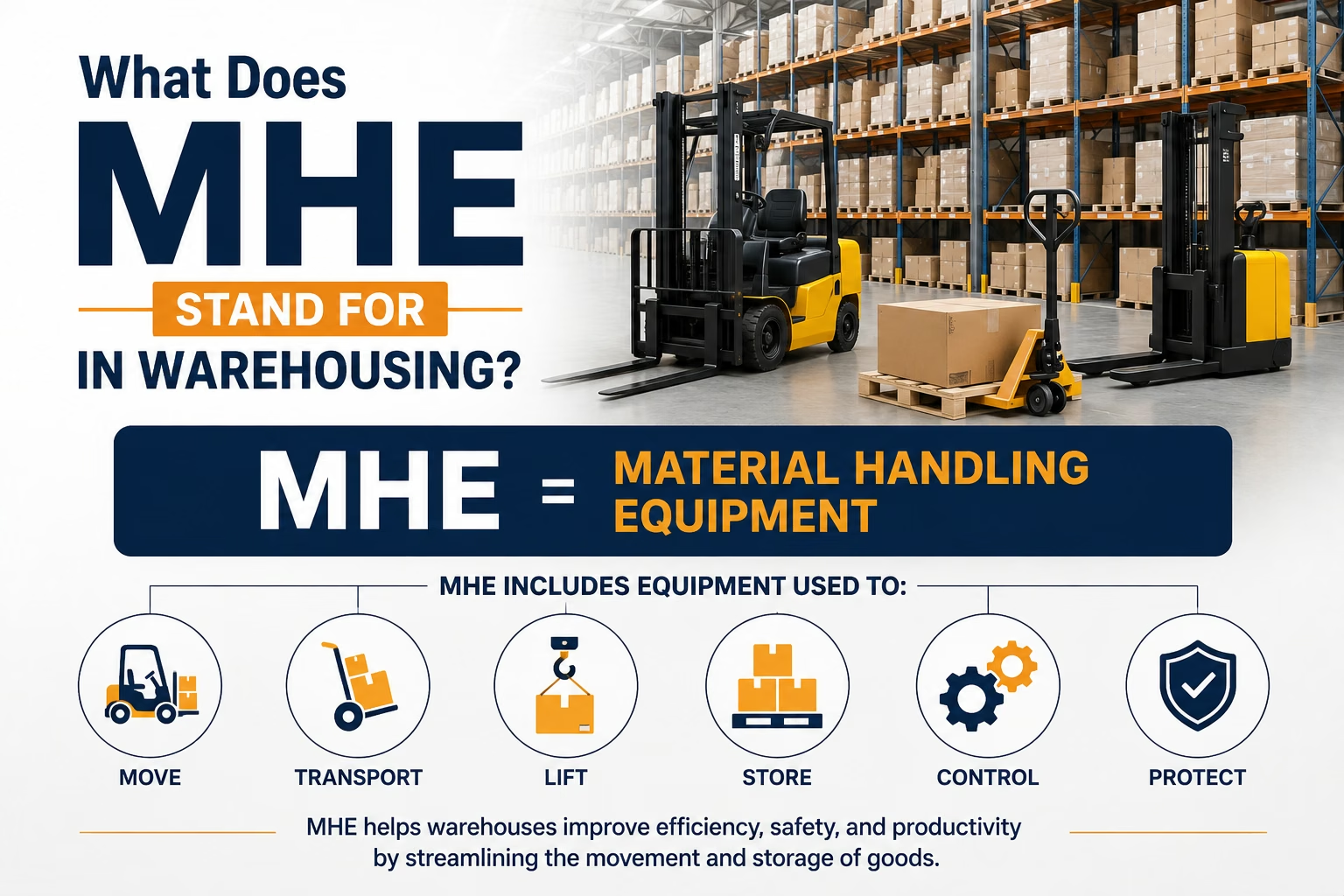
So, let’s cut to the chase, shall we? MHE stands for Material Handling Equipment. Simple, right? But the beauty, the true depth of that simple definition, is what most people miss. It’s not just about what it is, but what it does and what it enables. It’s the unsung hero of the supply chain, the facilitator of commerce, and the silent partner in every successful warehouse operation.
The Essence of “Material Handling”
Think about it. “Material handling” itself is a broad church. It’s the science and art of moving, storing, protecting, and controlling materials throughout the manufacturing, warehousing, distribution, consumption, and disposal processes. Every single item, from the smallest screw to the largest engine block, needs to be handled at some point. And when you’re talking about industrial scale, you can’t rely on brute force and a strong back. That’s where MHE steps in, making the impossible possible, the slow fast, and the dangerous safe.
The “Equipment” That Makes It Happen
Now, the “equipment” part. This is where it gets really interesting, and where my nearly 50 years of experience truly shine. Because “equipment” isn’t just one thing; it’s an entire ecosystem of machines, tools, and systems designed for specific tasks. When I first started, electric forklifts were a novelty, and automated systems were the stuff of science fiction. Today? They’re commonplace, and we’re pushing the boundaries further with robotics and AI.
In the context of warehousing, understanding the term MHE, which stands for Material Handling Equipment, is crucial for optimizing operations. For those looking to delve deeper into best practices related to material handling, a valuable resource is the article found at Material Handling Best Practices. This article provides insights into efficient strategies and equipment that can enhance productivity and safety in warehouse environments.
The Core Categories of MHE: A Warehouse’s Anatomy
To truly grasp MHE, you need to understand its constituent parts. Think of a warehouse as a living organism, and MHE as its skeleton, muscles, and even its nervous system. Each piece plays a vital role.
Industrial Trucks: The Workhorses of the Warehouse
Ah, the industrial truck. This is probably what most people picture when they hear MHE. And for good reason – they are the absolute stalwarts, the tireless movers of goods.
- Forklifts (Lift Trucks): The undisputed king. You’ve got your counterbalanced forklifts, reach trucks for narrow aisles and high racking, pallet jacks (manual and electric), order pickers for individual items, turret trucks for very high-density storage, and even specialized rough terrain forklifts. Each one is designed for a specific purpose, a particular kind of load, and a unique operating environment. Knowing which one to recommend, or even to invent for a customer’s unique challenge, has been the highlight of my career.
- Aisle Masters/VNA Trucks: These are the superheroes in tight spaces. They work in very narrow aisles, which means you can pack more product into your existing footprint. This is a game-changer for businesses looking to maximize their warehouse space without building new.
- Tow Tractors/Tuggers: While forklifts lift, tow tractors pull. They’re fantastic for moving multiple trailers or carts of goods across long distances within a facility, common in manufacturing plants or large distribution centers.
Storage and Handling Equipment: Maximizing Your Footprint
It’s not just about moving; it’s about storing intelligently. Every square foot of warehouse space costs money, and MHE helps you make the most of it.
- Pallet Racking Systems: From selective racking (most common) to drive-in, drive-through, push-back, pallet flow, and even cantilever racking for long, awkward items – these are the bones of your storage strategy. I’ve designed more racking layouts than I can count, each one a puzzle to optimize flow and storage density.
- Shelving and Bins: For smaller items, individual parts, or less-than-pallet quantities, shelving – whether static, mobile, or modular – is crucial. And the right bins keep things organized and easily accessible.
- Mezzanines: When you run out of floor space, go up! Mezzanines add a whole new floor area without adding to your building’s footprint. It’s like magic, creating space where there was none before.
Understanding what MHE stands for in warehousing is crucial for optimizing operations and improving efficiency. For those looking to delve deeper into the world of material handling, a related article on automated systems can provide valuable insights. You can explore how these systems enhance productivity and streamline processes in warehouses by visiting this informative article. By integrating advanced technology, businesses can significantly reduce labor costs and improve overall workflow.
Automated Material Handling Systems: The Future is Now
This is where MHE gets really exciting, blurring the lines between equipment and true technology. This segment has exploded in my lifetime, and it’s transformative.
- Conveyor Systems: From simple gravity rollers to sophisticated powered belt, chain, and roller conveyors, these systems are the arteries of a modern warehouse, tirelessly moving goods from one point to another, often without human intervention.
- Automated Storage and Retrieval Systems (AS/RS): These impressive systems use robots or stacker cranes to automatically store and retrieve items from high-density racks. Imagine a towering bookcase where a robotic arm fetches your specific book – that’s AS/RS at play, but for industrial products.
- Automated Guided Vehicles (AGVs) and Autonomous Mobile Robots (AMRs): AGVs follow fixed paths like tracks on the floor, while AMRs use advanced navigation to find the most efficient route, often collaborating with humans. They’re the future of internal transport, reducing labor costs and improving safety.
- Robotic Palletizers/Depalletizers: These clever robots automatically stack cases onto pallets or unload them, a task that’s repetitive and can be physically demanding for human workers.
Why MHE is More Than Just “Stuff”: The Impact on Operations
Understanding what MHE is only half the story. The real secret, the real juice, is understanding why it’s so critical. It’s not just an expense; it’s an investment that pays dividends many times over.
Enhancing Safety and Ergonomics
This is paramount. Manual handling is the leading cause of injuries in warehouses. MHE takes the strain, the lifting, the twisting, and the repetitive movements away from workers. A well-designed MHE system reduces accidents, minimizes worker fatigue, and improves overall morale. I’ve seen warehouses transform from dangerous, back-breaking environments to efficient, safe workplaces, almost entirely due to the thoughtful implementation of MHE.
Boosting Efficiency and Productivity
This is the big one. Time is money, and MHE saves both. When you can move more goods faster, store them more densely, and retrieve them more accurately, your entire operation becomes more productive.
- Reduced Handling Times: Think about how long it would take to move a pallet of goods manually versus with a forklift. No contest.
- Optimized Space Utilization: Racking and AS/RS allow you to utilize vertical space, effectively increasing your storage capacity without expanding your building.
- Streamlined Workflows: Conveyors and AGVs can connect different zones of a warehouse, creating a smooth, continuous flow of goods, eliminating bottlenecks.
Improving Accuracy and Inventory Management
Believe it or not, the right MHE can contribute significantly to better inventory control.
- Integration with WMS (Warehouse Management Systems): Modern MHE, especially automated systems, often integrates seamlessly with WMS software. This means real-time data on inventory location, movement, and counts, leading to far fewer errors.
- Reduced Damage: Proper handling by equipment designed for the job reduces product damage compared to manual methods or using the wrong tools.
Reducing Operational Costs
While MHE can be a significant upfront investment, the long-term savings are undeniable.
- Lower Labor Costs: Automation can reduce the number of personnel required for certain tasks, allowing existing staff to focus on more complex, value-added activities.
- Energy Efficiency: Modern electric forklifts and automated systems are designed to be energy-efficient, lowering utility bills.
- Less Product Damage: As mentioned, reduced damage means fewer scrapped items and fewer customer returns, both of which cost money.
Please visit material handling equipment for all your warehouse equipment needs.
My Two Cents: The Secret Sauce of Smart MHE Implementation
After all these years, if there’s one “secret” I can impart, it’s this: MHE isn’t a one-size-fits-all solution. It’s a precisely tailored suit. You can’t just buy the latest, fanciest robot and expect miracles. You need to understand your unique operation, your product, your throughput, your budget, and most importantly, your people.
Understanding Your Flow, Not Just Your Stuff
Before you even think about equipment, map out your material flow. Where do goods enter? Where do they go? How are they picked? How are they packed? Where do they leave? Every stage of this journey represents an opportunity for efficiency or a potential bottleneck. The right MHE addresses these specific points.
People, Process, Technology: The Holy Trinity
You can have the best MHE in the world, but without the right people to operate it, maintain it, and manage the processes around it, you’re just staring at expensive metal. Invest in training your staff, developing clear standard operating procedures, and choosing technology that complements, not complicates, your existing setup.
Don’t Be Afraid to Start Small and Scale Up
I’ve seen companies go bankrupt trying to implement a full-blown AS/RS too quickly. Sometimes, the most impactful change comes from something as simple as upgrading your pallet jack fleet or reconfiguring your racking. Start with common pain points, measure the improvements, and then build from there. The beauty of MHE is its modularity; you can always add more as your business grows and your needs evolve.
So, the next time someone asks “What does MHE stand for?”, you can do more than just rattle off “Material Handling Equipment.” You can explain the intricate dance of machines and systems that underpin modern commerce, the tireless workhorses, the silent engineers of efficiency, and the critical backbone of every successful supply chain. And believe me, that’s a story worth telling.
FAQs
What does MHE stand for in warehousing?
MHE stands for Material Handling Equipment in warehousing. It refers to the various tools and machinery used to move, store, protect, and control products and materials throughout the process of manufacturing, distribution, consumption, and disposal.
What are some examples of MHE in warehousing?
Examples of MHE in warehousing include forklifts, pallet jacks, conveyors, cranes, hoists, automated guided vehicles (AGVs), and robotics. These equipment are essential for the efficient and safe movement of goods within a warehouse.
Why is MHE important in warehousing?
MHE is important in warehousing because it helps to streamline operations, improve productivity, reduce manual labor, and ensure the safe handling of goods. It also plays a crucial role in optimizing space utilization and minimizing damage to products.
How does MHE impact warehouse efficiency?
MHE impacts warehouse efficiency by enabling faster and more accurate handling of goods, reducing downtime, and improving inventory management. It also contributes to cost savings and overall operational effectiveness.
What are the key considerations when selecting MHE for a warehouse?
Key considerations when selecting MHE for a warehouse include the specific needs of the operation, the type and volume of goods being handled, available space, budget constraints, and safety requirements. It is important to choose equipment that aligns with the unique demands of the warehouse environment.