
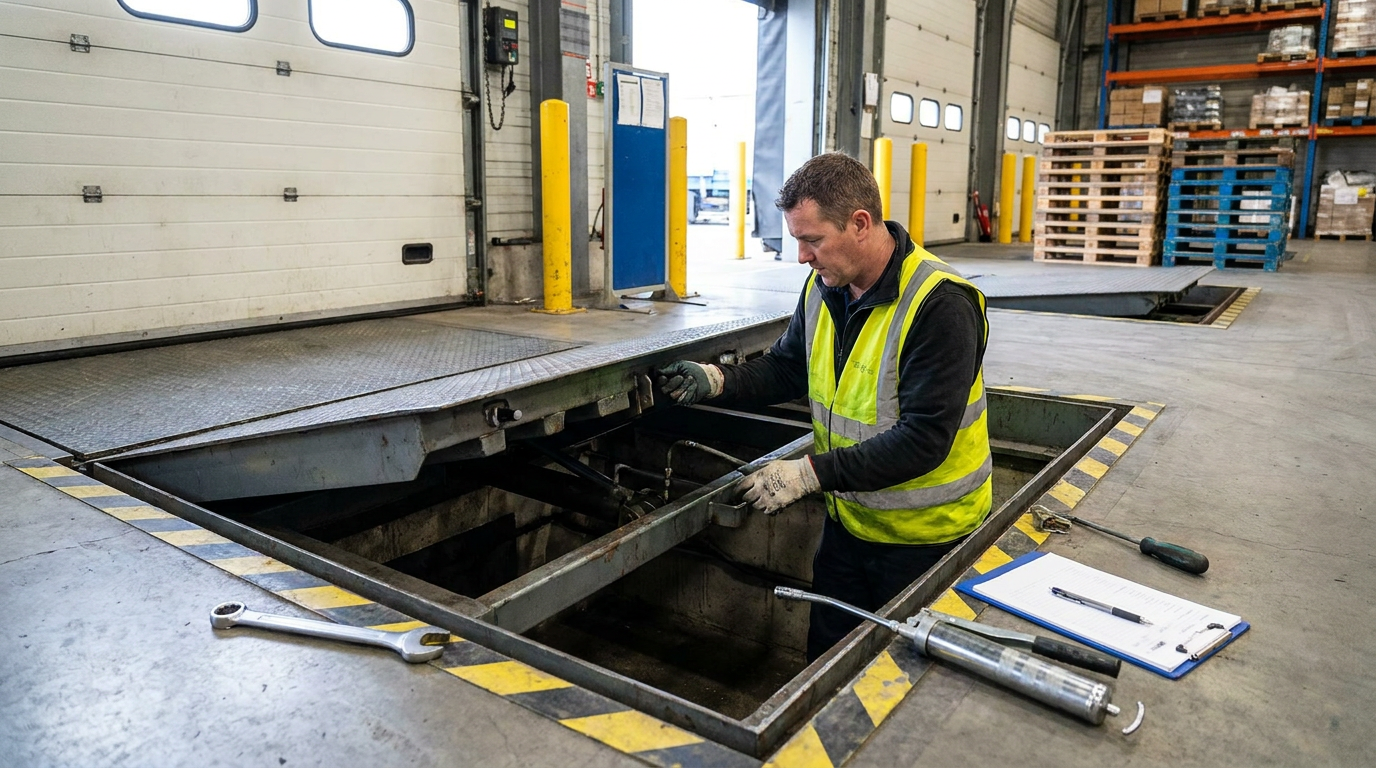
Dock Leveler Maintenance Checklist is one of the most important tools a facility can use to keep loading docks safe, productive, and compliant. For warehouse managers, plant engineers, maintenance supervisors, safety managers, and purchasing professionals, a structured checklist helps prevent unexpected downtime, reduce trailer-loading risks, protect employees, and extend the service life of critical loading dock equipment.
Dock levelers operate in demanding environments. They bridge the height difference between a loading dock and a truck trailer, supporting forklifts, pallet jacks, personnel, and heavy material handling equipment throughout the day. When a dock leveler is poorly maintained, the risks increase quickly: lip failure, deck drop, hydraulic leaks, uneven transitions, trailer separation, forklift impacts, product damage, and serious worker injuries.
This guide explains how dock levelers work, what to inspect, how often to maintain them, common problems, safety best practices, buying considerations, and mistakes to avoid.
A dock leveler is more than a convenience. It is a key part of the loading dock system, working alongside dock bumpers, dock seals, dock shelters, vehicle restraints, dock lights, trailer chocks, dock plates, and dock boards. If one part of the system fails, the entire loading process can become unsafe or inefficient.
Routine dock leveler maintenance helps facilities:
- Reduce unplanned downtime
- Improve loading dock safety
- Extend equipment life
- Lower repair costs
- Protect forklifts and pallet jacks
- Reduce product damage
- Improve trailer loading efficiency
- Support OSHA and ANSI-aligned safety programs
- Identify small issues before they become major failures
For high-volume distribution centers, manufacturing plants, cold storage facilities, food processing operations, and retail warehouses, a dock leveler failure can disrupt shipping schedules and create expensive bottlenecks.
The Cost of Neglecting Dock Levelers
A neglected dock leveler can create hidden costs that go beyond repair invoices. Common consequences include:
- Damaged forklift tires and suspension
- Product spills or load shifts
- Increased operator fatigue
- Trailer creep or separation hazards
- Slip, trip, and fall hazards
- Hydraulic fluid contamination
- Emergency service calls
- Worker compensation claims
- Delayed shipments and missed appointments
Preventive maintenance is almost always less expensive than reactive repair.
Proper maintenance of dock levelers is crucial for ensuring safety and efficiency in loading operations. For those looking to enhance their understanding of related equipment, an informative article on mezzanine stairs and railings can provide valuable insights into optimizing warehouse safety and accessibility. You can read more about this topic in the article titled “Mezzanine Stairs and Railing” available at this link.
How Dock Levelers Work
Dock levelers are designed to compensate for differences in height between the loading dock floor and the trailer bed. When activated, the leveler deck raises, the lip extends, and the deck lowers until the lip rests securely on the trailer floor. This creates a bridge for forklifts and other material handling equipment.
Main Components of a Dock Leveler
Most dock levelers include the following components:
| Component | Function |
|||
| Deck/platform | Main surface that supports traffic |
| Lip | Extends onto the trailer bed to create a transition |
| Hinges | Allow deck and lip movement |
| Springs or hydraulic cylinders | Provide lifting force depending on leveler type |
| Hold-down mechanism | Controls deck positioning on mechanical levelers |
| Hydraulic pump and lines | Power hydraulic levelers |
| Air bag or bellows | Lifts air-powered dock levelers |
| Safety legs/maintenance struts | Provide support during maintenance |
| Pit frame | Structural enclosure mounted in the dock pit |
| Toe guards | Help reduce pinch-point hazards |
| Control panel | Operates powered dock levelers |
Understanding these components makes it easier to perform inspections and identify early warning signs.
Types of Dock Levelers
Different dock leveler types have different maintenance needs.
Mechanical Dock Levelers
Mechanical dock levelers use springs and a hold-down mechanism. Operators typically pull a release chain to raise the deck and extend the lip.
Common maintenance points include:
- Spring tension
- Hold-down operation
- Lip extension
- Hinge lubrication
- Deck balance
- Release chain condition
Mechanical units are durable and cost-effective but require more operator effort and regular adjustment.
Hydraulic Dock Levelers
Hydraulic dock levelers use hydraulic cylinders, pumps, hoses, and controls to raise the deck and extend the lip.
Common maintenance points include:
- Hydraulic fluid level
- Hose condition
- Cylinder leaks
- Electrical controls
- Pump operation
- Lip cylinder performance
Hydraulic models are popular in high-use facilities because they are easier to operate and reduce physical strain.
Air-Powered Dock Levelers
Air-powered dock levelers use an air bag or bellows system to raise the deck.
Maintenance points include:
- Air bag condition
- Blower operation
- Electrical connections
- Lip mechanism
- Hinge points
Air-powered units offer a simpler alternative to hydraulic systems because they do not use hydraulic fluid.
Vertical Storing Dock Levelers
Vertical levelers store upright inside the facility, making them common in food, pharmaceutical, cold storage, and washdown environments.
Maintenance points include:
- Hydraulic system condition
- Stored-position locking system
- Cleanability
- Control sequence
- Pit cleanliness
- Seal interface
They help improve environmental control and reduce contamination risk but require careful safety procedures during inspection.
Dock Leveler Maintenance Checklist
A comprehensive dock leveler maintenance checklist should include daily, weekly, monthly, quarterly, and annual tasks. The right schedule depends on traffic volume, environment, leveler type, and manufacturer recommendations.
High-cycle docks may need more frequent inspections than low-use docks.
Daily Dock Leveler Inspection Checklist
Daily inspections should be quick, visual, and performed before loading activity begins. Operators or dock supervisors can complete these checks.
Inspect for:
- Visible structural damage
- Loose debris in the dock pit
- Bent or damaged lip
- Uneven deck movement
- Unusual noises during operation
- Oil or fluid leaks
- Missing or damaged warning labels
- Damaged control buttons
- Dock bumpers that are loose, crushed, or missing
- Trailer position and safe lip contact
- Proper operation of vehicle restraints, if installed
- Clear area around the dock leveler
Daily checks should also confirm that the dock area is free of trip hazards, pallet debris, shrink wrap, broken boards, ice, grease, and standing water.
Weekly Dock Leveler Maintenance Checklist
Weekly inspections go deeper and should be performed by trained maintenance personnel.
Check:
- Lip hinge pins and deck hinge pins
- Lip crown and extension
- Chain, pull ring, or release mechanism on mechanical units
- Dock leveler alignment in the pit
- Toe guards and side guards
- Welds and structural members
- Deck plate surface condition
- Pit walls and curb angles
- Warning lights and communication systems
- Dock seals or dock shelters for interference
- Dock bumpers for proper protection
Lubricate hinge points where required by the manufacturer. Do not over-lubricate, as excess grease can attract dirt and debris.
Monthly Dock Leveler Maintenance Checklist
Monthly maintenance should evaluate operating performance, adjustment, and safety features.
Tasks include:
- Clean the dock pit thoroughly
- Inspect all welds for cracks
- Check hydraulic fluid level on hydraulic units
- Inspect hydraulic hoses, fittings, and cylinders
- Test control panel operation
- Verify proper lip extension and retraction
- Inspect springs and hold-down mechanisms on mechanical units
- Check air bag or blower operation on air-powered units
- Inspect weather seals around the dock leveler
- Test below-dock and above-dock operation
- Confirm proper float range during trailer loading
- Inspect traffic lights and interlocks
- Test vehicle restraints if integrated with the leveler
Record all findings in a maintenance log. Documentation supports accountability, budgeting, safety audits, and warranty claims.
Quarterly Dock Leveler Maintenance Checklist
Quarterly maintenance is especially important for busy loading docks.
Recommended tasks:
- Perform full operational cycle testing
- Inspect and tighten mounting hardware
- Inspect hinge pin wear
- Check dock leveler pit for rust, corrosion, or concrete damage
- Verify hydraulic pressure settings if applicable
- Adjust mechanical spring tension if needed
- Inspect lip keepers and stops
- Review control panel wiring and conduit
- Check safety labels and replace damaged decals
- Inspect dock bumpers, dock seals, dock shelters, and vehicle restraints as a system
Quarterly service is also a good time to evaluate whether repeated issues indicate the dock leveler is undersized, overloaded, or nearing the end of its useful life.
Annual Dock Leveler Maintenance Checklist
Annual preventive maintenance should be detailed and may require a qualified loading dock technician.
Annual tasks may include:
- Full structural inspection
- Hydraulic fluid replacement if recommended
- Hydraulic system pressure testing
- Replacement of worn hinge pins or bushings
- Spring and hold-down system adjustment
- Inspection of weld integrity
- Pit cleaning and repainting where needed
- Control panel inspection
- Safety interlock testing
- Load capacity review
- Verification of ANSI/industry safety practices
- Review of operator training records
- Assessment of dock leveler suitability for current operations
Annual inspections should consider whether changes in forklift type, trailer type, load weight, or traffic volume have exceeded the original design assumptions.
Please visit this dock equipment guide for more information.
Safety Considerations for Dock Leveler Maintenance
Dock leveler maintenance involves serious hazards. The deck and lip are heavy, stored energy may be present, and pinch points can cause severe injury. Maintenance should only be performed by trained personnel following lockout/tagout procedures and the manufacturer’s instructions.
Lockout/Tagout Requirements
Before servicing a dock leveler, follow OSHA lockout/tagout principles under 29 CFR 1910.147 where applicable. This includes controlling hazardous energy sources such as:
- Electrical power
- Hydraulic pressure
- Pneumatic pressure
- Mechanical spring tension
- Gravity and stored energy
A proper lockout/tagout process generally includes:
- Notify affected employees.
- Shut down the equipment.
- Isolate energy sources.
- Apply locks and tags.
- Release stored energy.
- Verify zero-energy state.
- Use maintenance struts or approved support devices.
- Complete service.
- Remove tools and personnel.
- Restore power only after confirming safe conditions.
Never rely on hydraulic pressure alone to support a raised dock leveler.
Use Maintenance Struts Correctly
A maintenance strut or service stand must be used whenever personnel work beneath or near a raised dock leveler. The strut should be properly engaged and rated for the equipment.
Avoid these unsafe practices:
- Working under an unsupported deck
- Using wood blocks as a substitute for a proper support
- Standing in pinch-point areas during operation
- Reaching into the mechanism while the unit is cycling
- Bypassing controls or safety interlocks
OSHA and ANSI Best Practices
OSHA does not have a dock-leveler-specific standard for every maintenance task, but several OSHA requirements and recognized industry practices apply to loading dock safety.
Relevant areas include:
- OSHA 29 CFR 1910.147: Control of hazardous energy
- OSHA 29 CFR 1910 Subpart D: Walking-working surfaces
- OSHA 29 CFR 1910.178: Powered industrial trucks
- OSHA 29 CFR 1910.176: Material handling and storage
- OSHA general duty expectations for maintaining a safe workplace
ANSI MH30.1 is commonly referenced for dock leveling device design, performance, and safety guidance. Facility teams should also follow manufacturer instructions and applicable local codes.
Best practices include:
- Keep dock edges protected and clearly marked
- Train employees on dock leveler operation
- Use vehicle restraints, wheel chocks, or equivalent trailer-securing methods
- Maintain dock bumpers to prevent building and equipment damage
- Inspect dock plates and dock boards when used as alternatives
- Keep dock levelers within rated capacity
- Maintain communication between forklift operators and truck drivers
- Use dock lights and trailer lights to improve visibility
- Keep pedestrian traffic away from active dock positions
Proper maintenance of dock levelers is crucial for ensuring safety and efficiency in loading operations. To further enhance your understanding of equipment upkeep, you may find it beneficial to explore a related article that discusses essential safety practices in warehouse environments. This resource provides valuable insights that complement the dock leveler maintenance checklist. For more information, you can visit this helpful article that highlights best practices for maintaining a safe and efficient workspace.
Common Applications for Dock Levelers
| Checklist Item | Description |
|---|---|
| Visual Inspection | Inspect for any visible damage or wear on the leveler, lip, and frame |
| Hydraulic System | Check hydraulic fluid level and look for any leaks |
| Operational Test | Test the leveler to ensure it operates smoothly and without issues |
| Lubrication | Apply lubricant to moving parts as needed |
| Safety Features | Verify that all safety features, such as lip extension and automatic descent, are functioning properly |
Dock levelers are used anywhere goods move between trucks and facilities. They support safer and more efficient transitions for forklifts, pallet jacks, carts, and other material handling equipment.
Warehousing and Distribution
Distribution centers depend on dock levelers for fast trailer loading and unloading. High-cycle operations often prefer hydraulic dock levelers because they reduce operator fatigue and improve throughput.
Manufacturing and Industrial Plants
Plant engineers and maintenance teams use dock levelers to support inbound raw materials, outbound finished goods, and internal logistics. Heavy-duty levelers may be required for steel, paper, automotive, chemical, or equipment manufacturing.
Food and Beverage Facilities
Food and beverage operations often prioritize cleanability, environmental control, and temperature management. Vertical storing dock levelers, dock seals, dock shelters, and insulated doors may be used together to reduce contamination and energy loss.
Cold Storage and Refrigerated Warehousing
Cold storage docks need dock levelers that reduce air infiltration and prevent condensation, frost, and ice hazards. Proper maintenance of weather seals, dock shelters, and door systems is especially important.
Retail, Grocery, and E-Commerce
Fast-moving retail and e-commerce facilities require consistent dock performance. Any downtime can delay shipments and disrupt order fulfillment.
Benefits of Preventive Dock Leveler Maintenance
Preventive maintenance delivers operational, financial, and safety benefits.
Improved Loading Dock Safety
A well-maintained dock leveler reduces risks such as:
- Forklift jolts
- Trailer separation incidents
- Lip slippage
- Deck free-fall
- Pedestrian falls
- Product tip-overs
- Pinch-point injuries
When combined with vehicle restraints, dock bumpers, dock seals, and clear procedures, preventive maintenance supports a safer loading dock environment.
Reduced Downtime
Scheduled maintenance helps identify problems during planned service windows instead of during peak shipping hours. This is especially valuable for facilities with tight delivery schedules.
Longer Equipment Life
Dock levelers can last many years when properly maintained. Lubrication, adjustment, cleaning, and timely replacement of wear parts help prevent premature failure.
Lower Total Cost of Ownership
Preventive maintenance may reduce:
- Emergency repair costs
- Replacement part expenses
- Forklift damage
- Product loss
- Labor delays
- Safety incident costs
Purchasing professionals should consider maintenance costs as part of total cost of ownership, not just the initial purchase price.
Better Operator Experience
A dock leveler that cycles smoothly and creates a stable transition improves forklift operator comfort and confidence. This can reduce fatigue and improve productivity.
Limitations and Risks of Dock Levelers
Dock levelers are powerful tools, but they are not suitable for every application or condition.
Capacity Limitations
Every dock leveler has a rated capacity. Exceeding that rating can damage the deck, lip, hinges, cylinders, springs, or pit structure.
Capacity calculations should account for:
- Forklift weight
- Load weight
- Speed of travel
- Frequency of use
- Impact forces
- Trailer type
- Grade or incline
A common mistake is selecting a leveler based only on static load weight instead of dynamic loading conditions.
Environmental Limitations
Outdoor exposure, washdown areas, corrosive chemicals, salt, humidity, and extreme temperatures can accelerate wear. Facilities in harsh environments may need galvanized components, special coatings, stainless components, or more frequent maintenance.
Operational Limitations
Dock levelers require proper trailer positioning and adequate lip engagement. They should not be used if:
- The trailer is too low or too high for safe operation
- The lip does not rest securely on the trailer bed
- The trailer is not secured
- The leveler is visibly damaged
- The dock pit is obstructed
- The deck does not move smoothly
In some situations, dock plates, dock boards, edge-of-dock levelers, or lift tables may be more appropriate.
Dock Leveler Maintenance Table by Frequency
The following table provides a practical checklist format for facility teams.
| Frequency | Maintenance Task | Responsible Party |
||||
| Daily | Visual inspection for damage, leaks, debris, and safe lip contact | Dock operator or supervisor |
| Daily | Confirm trailer is secured with vehicle restraint or chocks | Dock operator |
| Daily | Check dock bumpers and dock area housekeeping | Dock supervisor |
| Weekly | Inspect hinges, lip, deck plate, and toe guards | Maintenance technician |
| Weekly | Lubricate approved pivot points | Maintenance technician |
| Monthly | Clean dock pit and inspect structural components | Maintenance team |
| Monthly | Check hydraulic fluid, hoses, fittings, and controls | Maintenance technician |
| Monthly | Test lip operation and full cycle movement | Maintenance technician |
| Quarterly | Tighten hardware and inspect welds | Maintenance team |
| Quarterly | Test interlocks, lights, and vehicle restraints | Maintenance/safety team |
| Annually | Complete professional inspection and adjustment | Qualified dock technician |
| Annually | Review capacity, traffic, and application suitability | Engineering/purchasing/safety |
Always compare this checklist with the manufacturer’s manual for your specific model.
Maintenance by Dock Leveler Type
Different dock leveler designs require different inspection priorities.
Mechanical Dock Leveler Maintenance
Mechanical dock levelers depend on springs, linkages, and hold-down mechanisms. They need careful adjustment to operate safely.
Inspect:
- Main springs
- Lip springs
- Hold-down mechanism
- Release chain and pull ring
- Lip latch
- Pivot pins
- Deck balance
- Ratchet bar or hold-down components
Common signs of trouble include hard pull effort, failure to rise, incomplete lip extension, and sudden deck movement.
Hydraulic Dock Leveler Maintenance
Hydraulic units are easier to operate but require inspection of fluid power components.
Inspect:
- Hydraulic cylinders
- Hoses and fittings
- Fluid reservoir
- Pump motor
- Electrical controls
- Push buttons
- Control box
- Velocity fuse or safety features
- Lip cylinder operation
Common symptoms include slow operation, uneven movement, fluid leaks, and failure to hold position.
Air-Powered Dock Leveler Maintenance
Air-powered dock levelers eliminate hydraulic fluid but rely on a lifting bag and blower.
Inspect:
- Air bag or bellows for cracks
- Blower motor
- Air connections
- Electrical controls
- Lip mechanism
- Hinge points
Common symptoms include weak lifting, excessive blower noise, and inconsistent deck rise.
Vertical Dock Leveler Maintenance
Vertical dock levelers require attention to stored-position safety and hydraulic performance.
Inspect:
- Upright locking system
- Hydraulic cylinders
- Control sequence
- Stored-position restraint
- Pit cleanliness
- Door and seal interface
- Dock shelter or seal alignment
Because these units store vertically, personnel must be trained on safe operating clearances and maintenance procedures.
Common Dock Leveler Problems and Troubleshooting
Troubleshooting should always begin with safety. If a dock leveler is damaged, unstable, leaking, or behaving unpredictably, remove it from service and contact a qualified technician.
Dock Leveler Will Not Raise
Possible causes:
- Loss of power
- Broken spring
- Hydraulic pump failure
- Low hydraulic fluid
- Air bag failure
- Damaged release chain
- Obstructed pit
- Faulty control switch
Recommended action:
- Lock out the equipment
- Check power supply if trained and authorized
- Inspect for visible obstructions
- Do not force the unit
- Contact service if the cause is not obvious
Lip Will Not Extend
Possible causes:
- Damaged lip hinge
- Broken lip spring
- Hydraulic lip cylinder issue
- Debris blocking movement
- Bent lip plate
- Misadjusted mechanism
Recommended action:
- Stop using the dock leveler
- Inspect for debris or visible damage
- Do not load over a lip that is not properly engaged
- Schedule repair or adjustment
Dock Leveler Drops Too Quickly
Possible causes:
- Hydraulic leak
- Failed velocity fuse
- Hold-down problem
- Damaged cylinder
- Mechanical adjustment issue
Recommended action:
- Remove from service immediately
- Follow lockout/tagout procedures
- Have a qualified technician inspect the system
A fast-dropping deck is a serious safety hazard.
Dock Leveler Is Noisy
Possible causes:
- Lack of lubrication
- Worn hinge pins
- Loose hardware
- Damaged structural components
- Misalignment
- Debris in pit
Recommended action:
- Inspect and lubricate as recommended
- Tighten hardware if trained
- Investigate unusual grinding, popping, or banging sounds
Hydraulic Fluid Leaks
Possible causes:
- Worn hoses
- Loose fittings
- Damaged seals
- Cylinder failure
- Overfilled reservoir
Recommended action:
- Clean spilled fluid promptly
- Use absorbent materials and proper disposal methods
- Prevent slip hazards
- Do not operate until the leak is corrected
Hydraulic fluid leaks can create environmental, fire, and slip hazards.
Uneven Transition Between Dock and Trailer
Possible causes:
- Trailer height mismatch
- Damaged lip
- Worn hinges
- Improper pit installation
- Dock bumper wear
- Trailer suspension movement
- Leveler not floating properly
Recommended action:
- Confirm trailer position and restraint
- Inspect lip contact
- Review application suitability
- Consider dock boards, dock plates, or alternate equipment if the height range is outside the leveler’s capability
Buying Factors for Dock Levelers
Purchasing professionals and facility managers should evaluate dock levelers based on application requirements, not just price.
Capacity Rating
Choose a dock leveler rated for the combined weight of forklifts, loads, and dynamic forces. Heavy forklift traffic requires higher capacity.
Consider:
- Maximum load weight
- Forklift weight
- Number of cycles per day
- Impact conditions
- Trailer types
- Future growth
Leveler Type
Select the leveler type based on usage and labor requirements.
| Type | Best For | Considerations |
||||
| Mechanical | Lower-cost applications | Requires more operator effort and adjustment |
| Hydraulic | High-use docks | Higher initial cost, smoother operation |
| Air-powered | Fluid-free operation | Air bag maintenance required |
| Vertical | Cold storage, food, clean facilities | Higher cost, excellent environmental control |
| Edge-of-dock | Limited height variation | Not suitable for all trailers or heavy duty use |
Dock Height and Trailer Range
Measure dock height and trailer bed heights. The dock leveler must accommodate the expected range without creating unsafe grades.
Lip Length
The lip must provide adequate trailer bed engagement. Longer lips may be needed for refrigerated trailers or special applications.
Pit Dimensions
Existing pit dimensions can affect replacement options. A retrofit may require pit modification, frame adapters, or custom equipment.
Controls and Integration
Modern loading docks may integrate:
- Dock leveler controls
- Vehicle restraints
- Overhead doors
- Dock lights
- Communication lights
- Security systems
- Fans and environmental controls
Interlocked systems can reduce human error and improve loading dock safety.
Environmental Conditions
For corrosive, wet, cold, or washdown environments, evaluate:
- Galvanized finish
- Stainless components
- Weather seals
- Insulation
- Hydraulic fluid type
- Pit drainage
- Dock seals or dock shelters
Serviceability
A dock leveler should be easy to inspect, maintain, and repair. Consider parts availability, technician access, manufacturer support, and warranty coverage.
Common Dock Leveler Maintenance Mistakes
Avoiding common mistakes can prevent costly failures and unsafe conditions.
Skipping Daily Inspections
Daily visual checks take only a few minutes but can catch obvious hazards before loading begins.
Ignoring Dock Bumpers
Dock bumpers protect the building, trailer, and dock leveler. Worn or missing bumpers can allow trailers to strike and damage the dock face or leveler.
Using a Damaged Dock Leveler
If the lip is bent, the deck is cracked, or the unit drops unexpectedly, remove it from service immediately.
Failing to Clean the Pit
Dock pits collect pallet fragments, stretch wrap, dirt, packaging, and moisture. Debris can interfere with leveler movement and accelerate corrosion.
Overloading the Equipment
Exceeding capacity is one of the fastest ways to damage a dock leveler. It also increases injury risk.
Bypassing Safety Interlocks
Bypassing controls, alarms, restraints, or communication lights can create serious hazards and liability.
Using Dock Plates or Dock Boards Incorrectly
Dock plates and dock boards can be useful for lower-capacity applications or temporary transitions, but they are not direct replacements for every dock leveler application. They must be rated, secured, and appropriate for the load and equipment being used.
Not Training Operators
Even a well-maintained dock leveler can be dangerous if operators are not trained. Training should cover proper use, trailer securing, communication, inspection, and emergency procedures.
Loading Dock Safety Best Practices
A dock leveler maintenance program should be part of a broader loading dock safety plan.
Secure Trailers Before Loading
Use vehicle restraints where possible. If vehicle restraints are not installed, use properly placed wheel chocks and follow company policy. Trailer creep and early departure are major hazards.
Maintain Dock Bumpers
Dock bumpers absorb trailer impact and help maintain proper spacing. Inspect them regularly for:
- Cracking
- Missing anchors
- Excessive compression
- Misalignment
- Separation from the dock wall
Use Dock Seals and Dock Shelters Correctly
Dock seals and dock shelters help control temperature, weather, dust, pests, and energy loss. However, damaged or misaligned seals can interfere with trailer positioning or visibility.
Inspect for:
- Torn fabric
- Crushed foam
- Damaged frames
- Loose mounting hardware
- Poor compression
- Water intrusion
Keep the Dock Area Clean
Housekeeping is a simple but powerful safety practice. Remove:
- Broken pallets
- Shrink wrap
- Loose strapping
- Spilled liquids
- Snow and ice
- Trash
- Unused dock plates or dock boards
Improve Visibility
Use dock lights, trailer lights, high-visibility markings, and communication lights. Forklift operators need clear sightlines inside trailers and around dock edges.
Maintenance Documentation and Recordkeeping
Good documentation supports safety, budgeting, compliance, and accountability.
A maintenance log should include:
- Equipment ID number
- Dock position
- Leveler type
- Manufacturer and model
- Capacity rating
- Inspection date
- Inspector name
- Findings
- Corrective actions
- Parts replaced
- Service technician notes
- Date returned to service
Digital maintenance systems can help track recurring issues, schedule preventive maintenance, and plan capital replacements.
When to Repair vs. Replace a Dock Leveler
Not every issue requires replacement, but there are times when replacement is the smarter investment.
Repair May Be Appropriate When:
- The leveler is structurally sound
- Parts are readily available
- Problems are isolated
- The unit fits current operational needs
- Repair cost is reasonable compared to replacement
Replacement May Be Better When:
- Structural cracks are present
- The deck or lip is severely worn
- The unit is repeatedly out of service
- Capacity is no longer adequate
- Parts are obsolete
- Safety features are outdated
- The pit or frame is damaged
- Operations have changed significantly
If your facility has upgraded forklifts, increased load weights, added shifts, or changed trailer types, your existing dock levelers may no longer be the best fit.
Sample Dock Leveler Inspection Form
Use the following sample as a starting point and adapt it to your facility and manufacturer requirements.
| Inspection Item | Pass/Fail | Notes |
||||
| Deck surface is free of cracks or major damage | | |
| Lip extends and retracts properly | | |
| Lip rests securely on trailer bed | | |
| Hinges and pins show no excessive wear | | |
| Pit is clean and free of debris | | |
| Hydraulic system has no visible leaks | | |
| Springs and hold-down system operate correctly | | |
| Controls function properly | | |
| Warning labels are visible | | |
| Dock bumpers are secure and intact | | |
| Vehicle restraint operates correctly | | |
| Dock seals or shelters are not interfering | | |
| Maintenance strut is present and functional | | |
| Unit is within rated capacity for operation | | |
Frequently Asked Questions About Dock Leveler Maintenance
How often should dock levelers be serviced?
Dock levelers should be visually inspected daily and maintained on a weekly, monthly, quarterly, and annual schedule. High-use docks may require more frequent service. Always follow the manufacturer’s recommendations.
Who should perform dock leveler maintenance?
Basic visual inspections can be performed by trained dock personnel. Mechanical, hydraulic, electrical, and structural repairs should be performed by qualified maintenance staff or professional loading dock service technicians.
What is the most common cause of dock leveler failure?
Common causes include lack of lubrication, hydraulic leaks, worn springs, damaged hinges, debris in the pit, overloading, and impact damage from trailers or forklifts.
Can a forklift operate over a dock leveler if the lip is not fully extended?
No. The lip must rest securely on the trailer bed before loading or unloading. Operating over an improperly positioned lip can cause a fall, load shift, or equipment damage.
Are dock plates and dock boards the same as dock levelers?
No. Dock plates and dock boards are portable bridging devices, while dock levelers are usually fixed equipment mounted at the dock. Dock boards are typically heavier-duty and may include curbs for forklift use, while dock plates are often used for lighter pallet jack applications.
What are signs that a dock leveler needs immediate repair?
Remove a dock leveler from service if you notice:
- Sudden deck drop
- Hydraulic leaks
- Bent or cracked lip
- Broken welds
- Failure to raise or lower properly
- Unusual loud noises
- Missing safety components
- Unstable trailer engagement
How long does a dock leveler last?
Service life varies based on use, maintenance, environment, and capacity. A properly maintained dock leveler can last many years, but high-cycle or harsh environments may shorten its lifespan.
Do dock levelers require OSHA inspections?
OSHA does not prescribe a universal dock leveler inspection interval for all facilities, but employers are responsible for maintaining a safe workplace. Lockout/tagout, powered industrial truck safety, walking-working surfaces, and material handling standards may apply. Regular inspections are a best practice and support compliance efforts.
Why are dock bumpers important to dock leveler maintenance?
Dock bumpers protect the dock face and help prevent trailer impact damage. If bumpers are worn or missing, trailers can damage the dock leveler, pit, wall, door, or building structure.
Should vehicle restraints be used with dock levelers?
Vehicle restraints are strongly recommended in many loading dock environments because they help prevent trailer creep and early departure. They work with dock levelers, communication lights, and loading dock procedures to improve safety.
Final Thoughts: Build a Safer Dock Leveler Maintenance Program
A reliable dock leveler maintenance checklist protects people, equipment, products, and productivity. By inspecting dock levelers daily, maintaining them on a scheduled basis, documenting service, and training operators, facilities can reduce risk and improve loading dock performance.
Dock levelers should never be viewed in isolation. They are part of a complete loading dock system that may include dock plates, dock boards, dock bumpers, dock seals, dock shelters, vehicle restraints, overhead doors, dock lights, and other material handling equipment. When these components are inspected and maintained together, your facility gains a safer and more efficient loading operation.
For expert help selecting, maintaining, repairing, or replacing dock levelers and related loading dock equipment, contact MHE Equipment. Our team can help you evaluate your application, improve loading dock safety, and choose the right solutions for your facility.
FAQs
What is a dock leveler?
A dock leveler is a piece of equipment used to bridge the gap between a loading dock and a truck or trailer, allowing for the safe and efficient transfer of goods.
Why is regular maintenance important for dock levelers?
Regular maintenance is important for dock levelers to ensure they continue to function properly, prevent accidents, and extend the lifespan of the equipment.
What are some common maintenance tasks for dock levelers?
Common maintenance tasks for dock levelers include checking for damaged or worn components, lubricating moving parts, inspecting hydraulic systems, and testing safety features.
How often should dock levelers be inspected and maintained?
Dock levelers should be inspected and maintained at least once a year, but more frequent inspections may be necessary depending on the level of usage and environmental conditions.
What are the consequences of neglecting dock leveler maintenance?
Neglecting dock leveler maintenance can lead to equipment failure, safety hazards for workers, increased repair costs, and potential disruptions to the supply chain.