
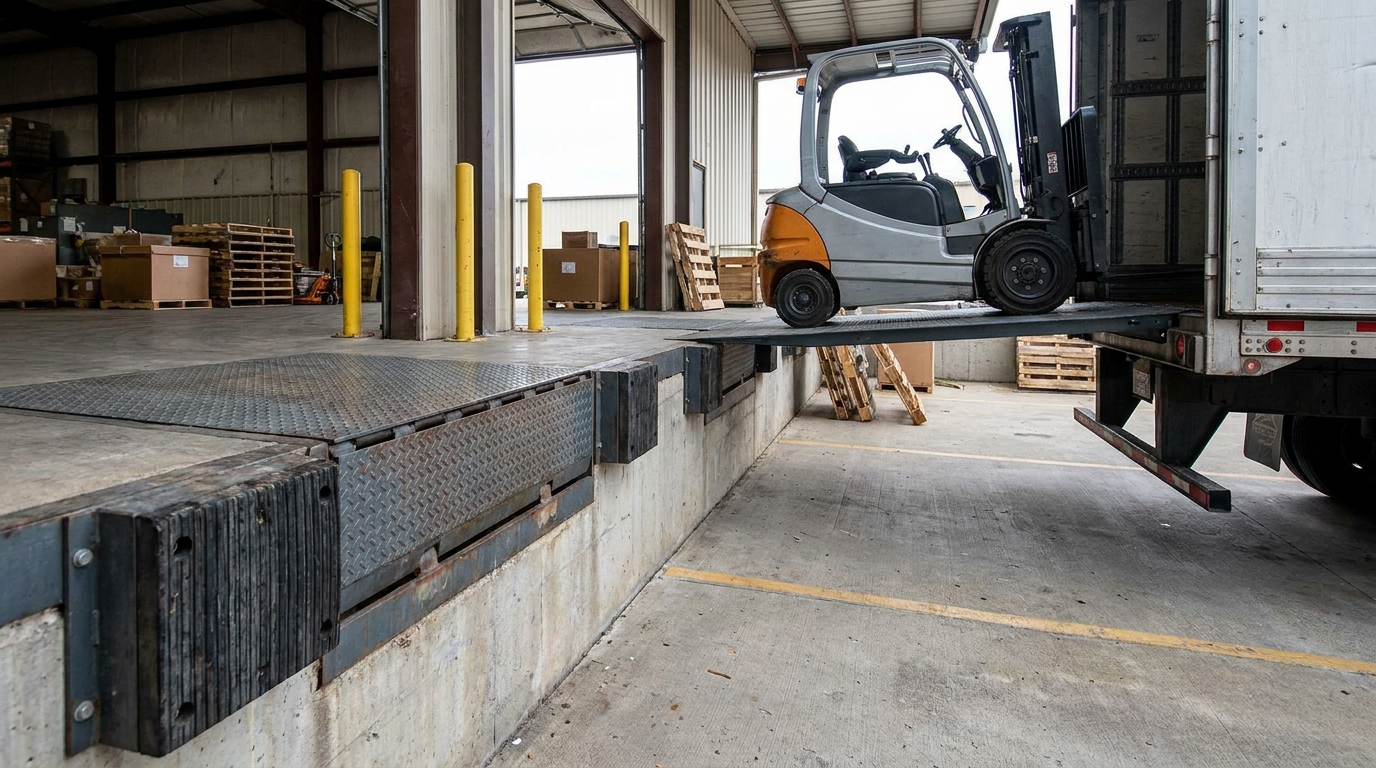
Mechanical vs. Hydraulic Dock Levelers is one of the most important comparisons warehouse managers, plant engineers, maintenance supervisors, safety managers, and purchasing teams make when evaluating loading dock equipment. The right dock leveler affects productivity, trailer access, employee safety, maintenance costs, and the long-term efficiency of your entire material handling operation.
At a busy loading dock, the dock leveler bridges the height gap between the building floor and a truck trailer bed. Without a reliable leveler, lift trucks, pallet jacks, carts, and other material handling equipment may struggle to move products safely in and out of trailers. Choosing between a mechanical dock leveler and a hydraulic dock leveler depends on your facility’s volume, budget, maintenance capabilities, safety requirements, and operating environment.
Below, we’ll break down how each type works, where each performs best, key benefits and limitations, OSHA/ANSI-related safety considerations, maintenance requirements, troubleshooting tips, buying factors, and common mistakes to avoid.
Dock levelers are permanent or semi-permanent pieces of loading dock equipment designed to compensate for height differences between the dock floor and truck trailer beds. They are commonly installed in a pit at the loading dock, although edge-of-dock levelers are also used in certain lower-volume applications.
A dock leveler typically includes:
- A platform or deck
- A hinged lip that extends into the trailer
- A lifting or counterbalance mechanism
- Safety supports or maintenance struts
- Controls or release mechanisms
- Bumpers to protect the dock face and equipment
Dock levelers are often used alongside dock bumpers, dock seals, dock shelters, vehicle restraints, trailer restraints, dock lights, dock plates, dock boards, and other loading dock safety systems.
Why Dock Leveler Selection Matters
The wrong dock leveler can create costly issues, including:
- Increased forklift impact and wear
- Employee strain or injury risk
- Trailer separation hazards
- Frequent downtime
- Higher maintenance costs
- Product damage
- Inefficient loading and unloading cycles
For facilities handling high truck volumes, heavy forklift traffic, cold chain products, food and beverage goods, manufacturing components, or retail distribution inventory, dock leveler performance directly impacts throughput and safety.
Mechanical vs. Hydraulic Dock Levelers at a Glance
| Feature | Mechanical Dock Leveler | Hydraulic Dock Leveler |
||||
| Operation | Spring/counterbalance operated | Powered hydraulic system |
| Activation | Pull chain or manual release | Push-button controls |
| Initial Cost | Lower | Higher |
| Ease of Use | Requires more physical effort | Easier and more ergonomic |
| Maintenance | More frequent adjustments | Less frequent mechanical adjustment |
| Best For | Moderate-volume docks, budget-conscious facilities | High-volume, safety-focused, productivity-driven docks |
| Safety | Good when maintained properly | Typically offers enhanced control and safety features |
| Power Requirement | Usually none | Requires electrical power |
| Lifespan | Long with proper maintenance | Long with proper maintenance |
| Common Concern | Spring tension, worn parts, manual effort | Hydraulic leaks, electrical issues |
When considering the best options for loading and unloading goods, it’s essential to understand the differences between mechanical and hydraulic dock levelers. For a more in-depth analysis of these two types of dock levelers, you can refer to the article on MHE Equipment, which provides valuable insights into their functionalities, advantages, and ideal applications. To read more, visit this link.
How Mechanical Dock Levelers Work
Mechanical dock levelers use a spring and counterbalance system to raise the platform and extend the lip. The operator typically pulls a release chain, which activates the hold-down mechanism and allows the leveler deck to rise. Once raised, the lip extends. The operator then walks the deck down until the lip rests on the trailer bed.
Mechanical levelers have been widely used for decades because they are durable, cost-effective, and do not usually require electrical power.
Main Components of a Mechanical Dock Leveler
A typical mechanical dock leveler includes:
- Deck plate
- Lip assembly
- Main springs or counterbalance springs
- Hold-down mechanism
- Hinge pins
- Lip extension mechanism
- Safety legs
- Toe guards
- Maintenance strut
- Dock bumpers
The springs do most of the lifting work, but the operator still plays an active role in positioning the leveler.
Mechanical Dock Leveler Operating Sequence
A standard mechanical dock leveler operates as follows:
- The trailer backs into position against the dock bumpers.
- The trailer is secured with wheel chocks or a vehicle restraint.
- The operator pulls the release chain.
- The leveler deck rises using spring force.
- The lip extends outward.
- The operator walks the deck down.
- The lip rests on the trailer bed.
- Loading or unloading begins.
- After use, the leveler returns to its stored position.
Advantages of Mechanical Dock Levelers
Mechanical dock levelers remain popular because they offer:
- Lower upfront purchase cost
- No electrical power requirement in most designs
- Rugged construction
- Familiar operation for experienced dock workers
- Suitable performance for moderate traffic
- Simpler installation in some applications
For smaller warehouses, seasonal operations, or facilities with limited capital budgets, mechanical dock levelers can be a practical choice.
Limitations of Mechanical Dock Levelers
Mechanical units also have drawbacks:
- Require physical effort to operate
- Need regular spring tension adjustments
- Can be harder to use for some employees
- More moving mechanical parts may require attention
- Improper adjustment can cause poor performance
- Less convenient for high-cycle docks
- May encourage unsafe shortcuts if difficult to operate
If operators avoid using a mechanical dock leveler correctly because it is hard to pull, release, or walk down, the safety risk increases significantly.
How Hydraulic Dock Levelers Work
Hydraulic dock levelers use hydraulic cylinders, pumps, hoses, and push-button controls to raise and lower the deck and extend the lip. Instead of pulling a chain and manually walking the deck down, the operator presses a button to activate the system.
Hydraulic dock levelers are widely used in high-volume distribution centers, manufacturing plants, food processing facilities, cold storage warehouses, and operations where safety, ergonomics, and productivity are priorities.
Main Components of a Hydraulic Dock Leveler
A hydraulic dock leveler typically includes:
- Deck plate
- Hydraulic lift cylinder
- Hydraulic lip cylinder
- Hydraulic pump and motor
- Control panel
- Electrical components
- Hydraulic hoses and fittings
- Lip assembly
- Safety velocity fuse or fall protection features
- Maintenance strut
- Dock bumpers
Some advanced hydraulic systems integrate with vehicle restraints, dock lights, communication systems, overhead doors, dock seals, and interlock controls.
Hydraulic Dock Leveler Operating Sequence
A standard hydraulic dock leveler operates as follows:
- Trailer backs into the dock position.
- Dock bumpers help protect the building and trailer.
- Vehicle restraint or wheel chocks secure the trailer.
- Operator presses the control button.
- Hydraulic system raises the deck.
- Lip extends hydraulically.
- Operator releases the control, allowing the leveler to lower onto the trailer bed.
- Loading or unloading begins.
- Operator returns the leveler to the stored position with push-button controls.
Advantages of Hydraulic Dock Levelers
Hydraulic dock levelers offer several operational benefits:
- Push-button operation
- Reduced physical strain on employees
- Faster loading dock cycles
- Better control during operation
- Fewer manual adjustments
- Good choice for high-volume facilities
- Often compatible with advanced safety interlocks
- Smooth lip extension and deck movement
- Lower risk of operator misuse due to difficult manual operation
For safety managers and maintenance supervisors, the ergonomic and control benefits often justify the higher initial cost.
Limitations of Hydraulic Dock Levelers
Hydraulic dock levelers are not perfect for every application. Potential limitations include:
- Higher upfront cost
- Requires electrical power
- Hydraulic components can leak if damaged or neglected
- Electrical troubleshooting may require trained technicians
- More complex installation than some mechanical models
- Downtime can be more disruptive if the hydraulic system fails
That said, many facilities find that hydraulic dock levelers reduce lifetime maintenance frustration compared with poorly maintained mechanical units.
Please visit this dock equipment guide for more information.
Mechanical vs. Hydraulic Dock Levelers: Key Comparison Factors
When comparing mechanical vs. hydraulic dock levelers, the best choice depends on more than price. Consider the total cost of ownership, operator experience, safety goals, dock volume, trailer types, and maintenance resources.
Initial Cost vs. Lifetime Cost
Mechanical dock levelers usually cost less upfront. For low- to medium-volume docks, this can make sense. However, lower purchase price does not always mean lower lifetime cost.
Hydraulic dock levelers often cost more initially, but they may provide savings through:
- Reduced operator fatigue
- Faster cycle times
- Fewer manual adjustments
- Better safety integration
- Lower risk of misuse
- Less frequent spring-related maintenance
| Cost Category | Mechanical Dock Leveler | Hydraulic Dock Leveler |
||||
| Purchase Price | Lower | Higher |
| Installation Cost | Generally moderate | Moderate to higher |
| Routine Maintenance | More mechanical adjustment | Hydraulic/electrical inspection |
| Operator Labor Effort | Higher | Lower |
| Downtime Risk | Moderate if poorly adjusted | Lower when maintained properly |
| Long-Term Value | Good for moderate use | Excellent for high-volume use |
Ergonomics and Operator Effort
Mechanical levelers require operators to pull a release chain and walk the deck down. This may seem simple, but repeated use over hundreds of cycles can contribute to fatigue.
Hydraulic levelers reduce physical effort through push-button operation. For facilities focused on ergonomics, labor retention, and injury prevention, this is a major advantage.
Loading Dock Productivity
In high-volume operations, small delays add up. If a mechanical dock leveler takes longer to position or requires multiple attempts due to poor adjustment, productivity suffers.
Hydraulic dock levelers support faster, more consistent operation. This is especially valuable where trucks are scheduled tightly, such as:
- E-commerce fulfillment centers
- Grocery distribution centers
- Manufacturing plants
- Cross-dock operations
- Third-party logistics facilities
- Food and beverage warehouses
Maintenance Requirements
Mechanical dock levelers need regular attention to springs, hold-downs, hinges, lip mechanisms, and deck balance. If the spring tension is wrong, the leveler may pop up too aggressively or fail to rise fully.
Hydraulic dock levelers require inspection of hydraulic fluid, hoses, fittings, cylinders, pumps, motors, and electrical controls. They typically have fewer manual operating issues but require technicians familiar with hydraulic systems.
Safety Performance
Both mechanical and hydraulic dock levelers can be safe when properly selected, installed, maintained, and used. However, hydraulic models often provide enhanced control and can integrate with modern loading dock safety systems.
Examples include:
- Vehicle restraints
- Red/green dock communication lights
- Door interlocks
- Leveler interlocks
- Trailer presence sensors
- Advanced control panels
Mechanical dock levelers can also be part of a safe dock system, but they rely more heavily on correct operator use and consistent maintenance.
When considering the best options for loading and unloading operations, it’s essential to understand the differences between mechanical and hydraulic dock levelers. For a deeper insight into how these systems can impact efficiency and safety in your warehouse, you might find this related article on special offers particularly useful. It provides valuable information that can help you make an informed decision about which type of dock leveler suits your needs best. Check it out here: special offers.
Common Applications for Mechanical and Hydraulic Dock Levelers
| Features | Mechanical Dock Levelers | Hydraulic Dock Levelers |
|---|---|---|
| Operation | Manual operation | Hydraulic operation |
| Maintenance | Requires regular maintenance | Low maintenance |
| Cost | Lower initial cost | Higher initial cost |
| Capacity | Lower weight capacity | Higher weight capacity |
| Installation | Easy installation | Complex installation |
Different facilities have different loading dock needs. The right leveler depends on truck frequency, load weight, forklift type, trailer variation, and environmental requirements.
Best Applications for Mechanical Dock Levelers
Mechanical dock levelers are commonly used in:
- Small warehouses
- Light manufacturing facilities
- Lower-volume shipping docks
- Facilities with limited electrical access
- Budget-conscious operations
- Seasonal businesses
- Backup or secondary dock positions
They are a practical option when dock traffic is moderate and maintenance teams can keep springs and moving parts properly adjusted.
Best Applications for Hydraulic Dock Levelers
Hydraulic dock levelers are well suited for:
- High-volume distribution centers
- Cold storage warehouses
- Food processing plants
- Pharmaceutical facilities
- Heavy manufacturing plants
- Automotive suppliers
- 24/7 operations
- Facilities using advanced loading dock safety systems
They are especially valuable where frequent use, heavy loads, or operator safety requirements justify a more automated solution.
Special Considerations for Cold Storage and Food Facilities
Cold storage, refrigerated warehouses, and food-grade facilities often need tighter environmental control. Dock levelers may be paired with:
- Dock seals
- Dock shelters
- Insulated overhead doors
- Brush seals
- Weather seals
- Trailer restraints
- Energy-saving dock control systems
Hydraulic dock levelers are often preferred in these environments because they support faster door-open times and can integrate with dock seals and shelters to reduce energy loss, pest entry, and temperature fluctuations.
Benefits of Choosing the Right Dock Leveler
Selecting the correct dock leveler improves more than trailer access. It affects safety, equipment life, employee morale, product protection, and operating costs.
Improved Loading Dock Safety
A properly specified dock leveler helps reduce risks such as:
- Forklift jolts
- Trailer bed height mismatch
- Dock edge exposure
- Pallet jack instability
- Product tipping
- Employee slips, trips, and falls
- Trailer creep or separation hazards
When paired with vehicle restraints, dock bumpers, dock lights, and clear communication signals, dock levelers become part of a complete loading dock safety program.
Better Material Handling Efficiency
Dock levelers create smoother transitions for:
- Forklifts
- Electric pallet jacks
- Manual pallet jacks
- Carts
- Tuggers
- Walkie stackers
- Other material handling equipment
A smoother path reduces impact on equipment, drivers, pallets, and products.
Reduced Equipment Damage
Steep transitions and uneven trailer access can damage:
- Forklift tires
- Pallet jack wheels
- Dock leveler lips
- Trailer floors
- Product packaging
- Racking components near staging areas
A properly rated dock leveler with adequate deck length and capacity helps reduce shock loads and impact damage.
Higher Employee Satisfaction
Operators notice when dock equipment is difficult or unsafe to use. Hydraulic dock levelers, in particular, can improve the employee experience by reducing repetitive physical effort.
This matters in a labor market where retention, safety culture, and productivity are all connected.
Limitations and Potential Drawbacks
Even high-quality dock levelers have limitations. Understanding these limitations helps facilities avoid unsafe use and premature failure.
Capacity Is Not the Same as Load Weight
A common mistake is assuming the dock leveler capacity only needs to match the weight of the heaviest load. In reality, capacity must account for:
- Forklift weight
- Load weight
- Speed of travel
- Frequency of use
- Impact forces
- Grade difference
- Number of cycles per day
A 10,000-pound forklift carrying a 4,000-pound pallet creates more stress than the load weight alone suggests. Always evaluate gross vehicle weight and dynamic loading.
Dock Levelers Are Not Dock Plates or Dock Boards
Dock plates and dock boards are portable solutions used to bridge gaps in certain loading situations. They are not direct replacements for pit-style dock levelers in high-volume forklift operations.
- Dock plates are usually lighter-duty and often used for hand trucks or pallet jacks.
- Dock boards are heavier-duty and may include curbs for forklift use.
- Dock levelers are fixed dock solutions designed for frequent trailer access.
Using a dock plate where a dock leveler is required can create serious safety and productivity problems.
Not Every Leveler Fits Every Trailer
Trailer bed heights vary. Standard dock height is commonly around 48 inches, but trailers may range significantly depending on type and load condition.
Common trailer types include:
- Dry vans
- Refrigerated trailers
- Flatbeds
- Step vans
- Container chassis
- Low-boy trailers
- Liftgate trucks
If your facility handles a wide range of trailer heights, you may need longer dock levelers, special lip lengths, edge-of-dock solutions, or other equipment modifications.
OSHA, ANSI, and Loading Dock Safety Best Practices
OSHA regulations do not provide one single detailed dock leveler standard for every situation, but several OSHA requirements and recognized industry standards apply to loading dock safety. ANSI/MH standards and manufacturer guidelines are also important for proper selection, use, inspection, and maintenance.
Facilities should always consult current OSHA regulations, ANSI/MH standards, local codes, equipment manuals, and qualified professionals.
OSHA-Related Safety Considerations
Relevant OSHA safety themes may include:
- Powered industrial truck safety
- Walking-working surfaces
- Hazard communication
- Lockout/tagout during maintenance
- Fall protection where applicable
- Employee training
- Equipment inspection
- Safe material handling practices
For loading docks, OSHA expects employers to provide a workplace free from recognized hazards. That means dock levelers, vehicle restraints, dock boards, dock plates, and related equipment should be properly maintained and safely used.
ANSI/MH and Manufacturer Guidance
ANSI and MHI-related standards provide guidance on dock leveler design, performance, marking, and use. While specific applicability depends on equipment type and jurisdiction, best practices generally include:
- Use dock levelers within rated capacity.
- Follow manufacturer installation instructions.
- Train operators on proper use.
- Inspect equipment regularly.
- Use maintenance struts before working beneath the deck.
- Keep hands and feet clear of pinch points.
- Do not operate damaged dock equipment.
- Secure trailers before loading or unloading.
- Keep dock edges clearly marked and protected.
Vehicle Restraints and Trailer Creep Prevention
Trailer creep occurs when a trailer gradually moves away from the dock due to forklift movement, suspension shifts, or other forces. This can create a dangerous gap between the dock and trailer.
Best practices include using:
- Vehicle restraints
- Wheel chocks where appropriate
- Red/green communication lights
- Trailer restraint interlocks
- Dock attendant procedures
- Driver communication protocols
Vehicle restraints are often preferred over wheel chocks in many modern facilities because they provide a more controlled and visible method of securing trailers.
Dock Bumpers, Dock Seals, and Dock Shelters
Dock bumpers protect the building, dock leveler, and trailer from impact damage. Worn or missing bumpers can cause trailer misalignment and damage dock equipment.
Dock seals and dock shelters help protect the loading area from:
- Rain
- Snow
- Wind
- Dust
- Pests
- Temperature loss
In temperature-controlled facilities, dock seals and shelters are important for energy efficiency and product protection.
Maintenance Best Practices for Mechanical and Hydraulic Dock Levelers
Preventive maintenance is essential for both mechanical and hydraulic dock levelers. A neglected leveler is more likely to fail, cause downtime, or create safety hazards.
Mechanical Dock Leveler Maintenance Checklist
Regular mechanical dock leveler maintenance should include:
- Inspect deck and lip for cracks or structural damage.
- Check hinge pins and bushings for wear.
- Lubricate pivot points according to manufacturer instructions.
- Inspect springs for corrosion, stretching, or damage.
- Adjust spring tension as needed.
- Check hold-down mechanism operation.
- Inspect lip extension and return.
- Confirm safety legs operate properly.
- Verify dock bumpers are intact.
- Clean debris from pit area.
- Inspect welds and frame components.
- Test full operating cycle.
Mechanical levelers should not slam upward, fail to rise, or resist normal operation. These symptoms often indicate adjustment or component issues.
Hydraulic Dock Leveler Maintenance Checklist
Hydraulic dock leveler maintenance should include:
- Inspect hydraulic hoses for leaks, cracks, or abrasion.
- Check hydraulic fluid level and condition.
- Inspect cylinders for leaks or scoring.
- Test pump and motor operation.
- Check electrical connections and controls.
- Inspect control panel buttons and wiring.
- Verify lip extension and retraction.
- Inspect deck, lip, hinges, and welds.
- Confirm safety stop or velocity fuse operation where applicable.
- Clean pit debris.
- Verify dock bumpers and weather seals.
- Test interlocks with doors or vehicle restraints if installed.
Only qualified personnel should service hydraulic and electrical components.
Recommended Inspection Frequency
Inspection frequency depends on usage, environment, and manufacturer recommendations.
| Dock Usage Level | Suggested Inspection Frequency |
|||
| Low-volume dock | Quarterly to semiannual inspection |
| Moderate-volume dock | Quarterly inspection |
| High-volume dock | Monthly or more frequent inspection |
| Harsh environment | Monthly or as conditions require |
| 24/7 operation | Weekly visual checks plus scheduled PM |
Daily operator checks are also recommended. Operators should report unusual noises, jerky movement, visible damage, leaking fluid, or unsafe conditions immediately.
Troubleshooting Common Dock Leveler Problems
Dock leveler problems should be addressed promptly. Continuing to use faulty equipment can damage the leveler, trailer, forklift, or building—and may put employees at risk.
Mechanical Dock Leveler Troubleshooting
| Problem | Possible Cause | Recommended Action |
||||
| Leveler will not raise | Broken spring, improper spring tension, jammed mechanism | Remove from service and inspect |
| Deck rises too fast | Over-adjusted springs | Have qualified technician adjust |
| Lip does not extend | Worn linkage, debris, damaged lip mechanism | Inspect, clean, repair |
| Leveler will not stay down | Hold-down issue | Service hold-down mechanism |
| Excessive noise | Dry pivots, worn hinges, loose hardware | Lubricate and inspect |
| Deck feels unstable | Structural damage or worn components | Stop use and evaluate |
Hydraulic Dock Leveler Troubleshooting
| Problem | Possible Cause | Recommended Action |
||||
| No response from controls | Power issue, blown fuse, control failure | Check power and call technician |
| Deck will not raise | Low fluid, pump issue, cylinder problem | Inspect hydraulic system |
| Lip will not extend | Lip cylinder issue, valve problem, obstruction | Remove from service |
| Jerky movement | Air in hydraulic system, low fluid, contamination | Service hydraulic system |
| Visible fluid leak | Damaged hose, fitting, or cylinder seal | Stop use and repair |
| Leveler drifts down | Valve or cylinder leak | Professional service required |
When to Remove a Dock Leveler from Service
Remove the dock leveler from service if you observe:
- Structural cracks
- Broken welds
- Missing or damaged safety components
- Hydraulic leaks
- Electrical faults
- Deck instability
- Failed lip extension
- Unusual movement
- Severe corrosion
- Missing dock bumpers
- Unsafe trailer contact
Use lockout/tagout procedures during maintenance as required, and never work under a dock leveler unless the maintenance strut or approved support device is properly engaged.
Buying Factors: How to Choose Between Mechanical and Hydraulic Dock Levelers
Purchasing professionals should evaluate both technical and operational factors before choosing a dock leveler. A low-cost leveler that does not match the application can become expensive quickly.
Dock Traffic Volume
The number of daily cycles is one of the biggest deciding factors.
- Low volume: Mechanical may be sufficient.
- Moderate volume: Mechanical or hydraulic may work depending on safety and labor goals.
- High volume: Hydraulic is usually preferred.
- 24/7 operation: Hydraulic or heavy-duty specialty leveler is often the better choice.
Load Capacity and Forklift Weight
Consider the full operating weight, not just pallet weight.
Evaluate:
- Forklift weight
- Maximum load weight
- Number of trips per trailer
- Travel speed
- Grade
- Impact forces
- Frequency of use
Common dock leveler capacities may range from 25,000 to 80,000 pounds or more, depending on the application. Heavy-duty manufacturing and high-cycle distribution may require reinforced designs.
Deck Length and Grade
Dock leveler length affects the grade between the dock and trailer. A steep grade can cause forklift underclearance problems, pallet jack difficulty, product instability, and increased impact.
Longer dock levelers are often needed for:
- Low trailers
- Tall dock heights
- Electric pallet jack use
- Low-clearance forklifts
- Fragile loads
- Heavy loads
Lip Length
Standard lips may not work for every trailer configuration. Longer lips may be required when trailers cannot position close enough to the dock or when using certain dock seals, shelters, or bumpers.
Environmental Conditions
Consider whether the dock is exposed to:
- Rain
- Snow
- Ice
- Washdown
- Corrosive materials
- Temperature extremes
- Food-grade sanitation requirements
- Dust or debris
Galvanized or corrosion-resistant components may be appropriate for harsh environments.
Integration with Other Loading Dock Equipment
Modern loading docks often use integrated systems. Your dock leveler may need to work with:
- Vehicle restraints
- Dock seals
- Dock shelters
- Dock bumpers
- Overhead doors
- Dock lights
- Control panels
- Security systems
- Loading dock safety barriers
- Material handling equipment workflows
Hydraulic dock levelers generally offer more integration options than mechanical units.
Budget and Return on Investment
Mechanical dock levelers may be the right answer when upfront cost is the primary concern and usage is moderate. Hydraulic dock levelers may provide better ROI when you factor in:
- Reduced labor effort
- Faster loading cycles
- Lower injury risk
- Better safety compliance
- Improved dock control
- Reduced downtime
- Longer-term operational efficiency
Common Mistakes to Avoid
Avoiding common dock leveler mistakes can save thousands of dollars and prevent serious safety incidents.
Mistake 1: Buying Based Only on Price
The cheapest dock leveler may not be the best value. Consider capacity, cycle frequency, safety features, maintenance requirements, and compatibility with your dock operation.
Mistake 2: Undersizing Capacity
Undersized dock levelers wear out faster and may fail under dynamic loading. Always account for forklift weight plus load weight and operating conditions.
Mistake 3: Ignoring Operator Ergonomics
If a mechanical dock leveler is difficult to use, employees may rush, skip steps, or use unsafe workarounds. Ergonomics should be part of the buying decision.
Mistake 4: Neglecting Dock Bumpers
Damaged dock bumpers can allow trailers to strike the dock face or leveler, causing structural damage. Bumpers are a small component with a big protective role.
Mistake 5: Confusing Dock Plates, Dock Boards, and Dock Levelers
Dock plates, dock boards, and dock levelers serve different applications. Using the wrong equipment can create serious hazards.
Mistake 6: Failing to Secure Trailers
A dock leveler does not prevent trailer creep by itself. Use vehicle restraints or proper wheel chocking procedures according to your facility’s safety program.
Mistake 7: Skipping Preventive Maintenance
Preventive maintenance is less expensive than emergency repair, product damage, or employee injury. Schedule inspections and document all service activity.
Mechanical vs. Hydraulic Dock Levelers: Which Is Better?
There is no universal answer. The better choice depends on your operation.
Choose a Mechanical Dock Leveler If:
- Your dock has low to moderate traffic.
- Upfront budget is a major concern.
- Electrical power is limited or unavailable.
- Your maintenance team can handle mechanical adjustments.
- Operators are trained and comfortable with manual operation.
- The dock position is not part of a high-speed loading process.
Choose a Hydraulic Dock Leveler If:
- Your facility has high dock traffic.
- Safety and ergonomics are top priorities.
- You want push-button operation.
- You need integration with vehicle restraints or dock controls.
- You handle heavy loads or frequent forklift traffic.
- You want smoother operation and improved productivity.
- Your facility operates multiple shifts or 24/7.
For many modern warehouses and manufacturing plants, hydraulic dock levelers are becoming the preferred choice because they support safer, faster, and more consistent loading dock operations. Mechanical dock levelers still remain a cost-effective and dependable solution where usage and budget conditions make sense.
Frequently Asked Questions About Mechanical vs. Hydraulic Dock Levelers
What is the main difference between mechanical and hydraulic dock levelers?
The main difference is the operating system. Mechanical dock levelers use springs and manual activation, while hydraulic dock levelers use hydraulic cylinders and push-button controls. Mechanical units typically cost less upfront, while hydraulic units offer easier operation and better ergonomics.
Are hydraulic dock levelers safer than mechanical dock levelers?
Both can be safe when properly installed, maintained, and used. However, hydraulic dock levelers often provide better control, reduced physical effort, and easier integration with vehicle restraints, dock lights, and interlock systems. These features can improve loading dock safety.
How long do dock levelers last?
With proper maintenance, dock levelers can last many years. Lifespan depends on usage frequency, load weight, environmental conditions, maintenance quality, and whether the leveler was correctly specified for the application.
Do mechanical dock levelers require electricity?
Most mechanical dock levelers do not require electricity for standard operation. This can be useful in facilities where power access is limited. However, accessories such as dock lights, fans, or communication systems may still require power.
Can hydraulic dock levelers leak?
Yes, hydraulic systems can leak if hoses, fittings, cylinders, or seals become damaged or worn. Regular inspection and preventive maintenance reduce the risk of leaks and unexpected downtime.
What capacity dock leveler do I need?
Capacity depends on forklift weight, maximum load weight, traffic frequency, speed, and impact conditions. Do not size the leveler based only on pallet weight. Consult a qualified loading dock equipment professional to determine the correct capacity.
Are dock plates and dock boards the same as dock levelers?
No. Dock plates and dock boards are portable bridging devices, while dock levelers are fixed or mounted loading dock systems. Dock boards are generally heavier-duty than dock plates, but neither is a direct substitute for a properly specified dock leveler in high-volume forklift applications.
Should I replace or repair an old dock leveler?
That depends on the condition, age, repair cost, capacity, and safety requirements. If the leveler has structural damage, obsolete parts, frequent breakdowns, or no longer matches your loading needs, replacement may be more cost-effective than repair.
How often should dock levelers be inspected?
Operators should visually check dock levelers daily or before use. Formal preventive maintenance may be monthly, quarterly, or semiannual depending on dock volume and environment. High-cycle docks require more frequent inspection.
Can dock levelers be integrated with vehicle restraints?
Yes. Hydraulic dock levelers are commonly integrated with vehicle restraints, overhead doors, dock lights, and control panels. Mechanical dock levelers may also be used with restraint systems, but hydraulic systems generally offer more advanced control options.
Final Thoughts: Making the Right Dock Leveler Investment
The decision between mechanical vs. hydraulic dock levelers should be based on safety, productivity, maintenance capacity, dock traffic, load requirements, and long-term value—not just upfront cost.
Mechanical dock levelers are durable, economical, and well suited for many moderate-use facilities. Hydraulic dock levelers provide push-button operation, improved ergonomics, higher productivity, and better compatibility with modern loading dock safety systems.
For the best results, evaluate your entire loading dock environment, including dock levelers, dock plates, dock boards, dock bumpers, dock seals, dock shelters, vehicle restraints, overhead doors, and material handling equipment. A well-designed dock system improves safety, protects employees, reduces equipment damage, and keeps freight moving efficiently.
If you are comparing mechanical and hydraulic dock levelers for your facility, contact MHE Equipment today. Our loading dock and material handling experts can help you evaluate your application, select the right equipment, improve loading dock safety, and plan a solution that fits your operational goals and budget.
FAQs
1. What is a mechanical dock leveler?
A mechanical dock leveler is a loading dock equipment that uses springs and a pull chain to operate. It is manually operated and does not require any hydraulic components.
2. What is a hydraulic dock leveler?
A hydraulic dock leveler is a loading dock equipment that uses hydraulic cylinders to raise and lower the platform. It is operated by a push-button control and provides a smoother and more controlled operation compared to mechanical dock levelers.
3. What are the advantages of a mechanical dock leveler?
Mechanical dock levelers are generally more cost-effective than hydraulic dock levelers. They also require less maintenance and have a simpler design, making them easier to install.
4. What are the advantages of a hydraulic dock leveler?
Hydraulic dock levelers provide a smoother and more controlled operation, making them ideal for high-traffic loading docks. They also offer a higher weight capacity and can accommodate a wider range of truck heights.
5. Which type of dock leveler is best for my loading dock?
The choice between a mechanical and hydraulic dock leveler depends on factors such as budget, expected usage, and maintenance preferences. Mechanical dock levelers are suitable for low to moderate usage and cost-conscious businesses, while hydraulic dock levelers are ideal for high-traffic docks and businesses that prioritize smooth and controlled operation.