
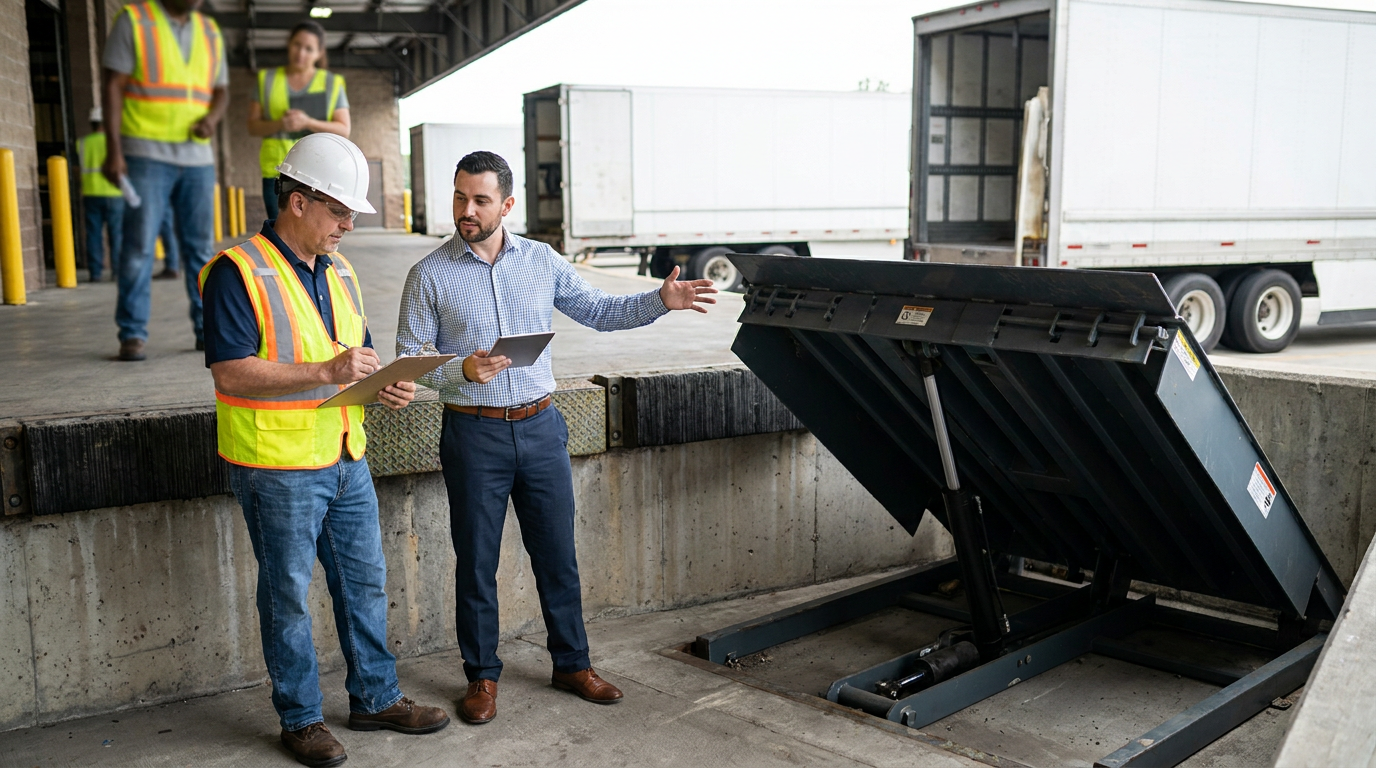
Edge dock leveler pricing guide resources help warehouse managers, plant engineers, maintenance supervisors, safety managers, and purchasing teams understand what they should expect to pay—and what factors drive the total cost—before investing in loading dock equipment.
Edge-of-dock levelers are one of the most common and cost-effective solutions for facilities that need to bridge the gap between a loading dock and a trailer. Compared with pit-style dock levelers, edge dock levelers are typically less expensive, easier to install, and well suited for many standard loading dock applications.
However, pricing can vary significantly depending on capacity, activation type, dock conditions, installation requirements, safety accessories, and long-term maintenance expectations. Choosing the cheapest option without evaluating your operation can lead to safety risks, premature equipment failure, product damage, and costly downtime.
This guide explains how edge dock levelers work, what they cost, where they are best used, key buying factors, maintenance requirements, safety considerations, and common mistakes to avoid.
An edge dock leveler, often called an EOD leveler, is a loading dock device mounted to the face of the dock rather than recessed into a pit. It creates a bridge between the dock floor and the bed of a truck or trailer, allowing pallet jacks, carts, and some forklifts to move safely during loading and unloading.
Unlike pit-style hydraulic or mechanical dock levelers, edge dock levelers are installed at the dock edge. They are commonly used in facilities with moderate loading volumes, limited dock space, or existing docks that were not originally built with leveler pits.
How an Edge Dock Leveler Works
An edge dock leveler typically includes:
- A steel deck plate
- A hinged lip
- Bumpers
- Mounting brackets
- Activation mechanism
- Optional safety features and accessories
When a trailer is backed into position, the operator activates the leveler. The deck raises, the lip extends onto the trailer bed, and the leveler settles into place. Once loading or unloading is complete, the leveler returns to its stored position.
Depending on the model, activation may be:
- Mechanical/manual
- Hydraulic
- Air-powered
- Assisted by spring or handle mechanisms
Most edge dock levelers are designed for relatively small height differences between dock and trailer bed. They typically handle service ranges of approximately 5 inches above or below dock height, though exact specifications vary by manufacturer and model.
If you’re looking to understand more about the factors that influence the pricing of edge dock levelers, you might find it helpful to read the related article on the importance of equipment maintenance and its impact on overall costs. This article provides valuable insights that can help you make informed decisions regarding your dock leveler investments. For more information, visit here.
Typical Edge Dock Leveler Pricing
Edge dock leveler pricing usually ranges from approximately $2,000 to $8,500+ per unit, depending on capacity, activation type, construction, accessories, and installation complexity.
Installed costs may be higher when concrete work, electrical service, dock face repair, custom mounting, or additional safety equipment is required.
General Price Range by Type
| Edge Dock Leveler Type | Typical Equipment Cost | Typical Installed Cost | Best For |
||:|:||
| Manual/mechanical edge dock leveler | $2,000–$4,500 | $3,000–$6,500 | Light to moderate use |
| Hydraulic edge dock leveler | $4,000–$7,500 | $5,500–$10,000+ | Frequent use, improved ergonomics |
| Air-powered edge dock leveler | $4,500–$8,500 | $6,000–$11,000+ | Facilities with air systems |
| Heavy-duty/high-capacity models | $6,000–$10,000+ | $8,000–$13,000+ | Heavier loads or more demanding service |
These prices are general estimates. Actual pricing depends on your dock height, equipment requirements, facility conditions, freight, labor, and regional market factors.
Manual Edge Dock Leveler Pricing
Manual or mechanical edge dock levelers are usually the lowest-cost option. They use a handle, spring assist, or mechanical activation system to raise and position the deck and lip.
Typical pricing:
- Equipment only: $2,000–$4,500
- Installed: $3,000–$6,500
Manual units are popular for facilities with:
- Lower loading frequency
- Occasional truck traffic
- Light to moderate palletized loads
- Budget-conscious projects
- Limited need for powered operation
The main advantage is affordability. The limitation is that manual operation requires more physical effort from employees. For high-volume docks, this can become an ergonomic concern.
Hydraulic Edge Dock Leveler Pricing
Hydraulic edge dock levelers use a push-button system to raise and lower the deck and lip. They cost more upfront but reduce operator effort and improve efficiency.
Typical pricing:
- Equipment only: $4,000–$7,500
- Installed: $5,500–$10,000+
Hydraulic models are commonly selected for:
- Busy shipping and receiving areas
- Facilities focused on worker ergonomics
- Operations with multiple dock cycles per shift
- Safety-conscious warehouses
- Environments where consistent operation is important
Hydraulic units may require electrical work, control stations, and additional maintenance of pumps, hoses, cylinders, and fluid systems.
Air-Powered Edge Dock Leveler Pricing
Air-powered edge dock levelers use an air bag or pneumatic system to raise the deck. They may be a good fit for facilities that already use compressed air systems.
Typical pricing:
- Equipment only: $4,500–$8,500
- Installed: $6,000–$11,000+
Air-powered levelers can reduce hydraulic fluid leak concerns, which may be valuable in food, beverage, pharmaceutical, or clean manufacturing environments. However, they require reliable air supply and proper system maintenance.
Key Factors That Affect Edge Dock Leveler Cost
The price of an edge dock leveler depends on more than the unit itself. A lower purchase price may not mean a lower total cost of ownership.
Capacity Rating
Capacity is one of the biggest pricing factors. Common edge dock leveler capacities include:
- 20,000 lb
- 25,000 lb
- 30,000 lb
- 35,000 lb
- Higher custom capacities in select designs
Capacity should be based on the combined weight of:
- Forklift or pallet jack
- Maximum load
- Dynamic forces during travel
- Frequency of use
- Uneven trailer conditions
A common mistake is selecting capacity based only on the heaviest pallet. In reality, a loaded forklift can create much higher forces than the pallet weight alone.
For example:
| Load Factor | Example Weight |
||:|
| Palletized product | 4,000 lb |
| Forklift | 9,000 lb |
| Operator and attachments | 500 lb |
| Dynamic travel forces | Variable |
| Recommended leveler capacity | Often 25,000 lb+ |
Higher-capacity levelers cost more, but under-sizing equipment can result in cracked welds, bent lips, unsafe transitions, and premature failure.
Dock Height and Service Range
Edge dock levelers are not ideal for every dock height. They work best when the trailer bed height is close to the dock height.
If your facility handles a wide range of trailers, including low vans, refrigerated trailers, flatbeds, or overseas containers, an edge dock leveler may not provide enough vertical range.
In those cases, you may need:
- Pit-style dock levelers
- Dock boards
- Dock plates
- Yard ramps
- Custom loading dock solutions
The more complex the dock height challenge, the more the total project may cost.
Activation Type
Manual models have the lowest initial cost, while hydraulic and air-powered models cost more but improve ergonomics and efficiency.
Consider:
- Number of dock cycles per day
- Employee fatigue
- Safety requirements
- Maintenance capabilities
- Availability of electrical or air service
- Long-term labor savings
For high-cycle docks, paying more for powered operation may be a better investment.
Dock Face Condition
Edge dock levelers mount directly to the face of the loading dock. If the dock face is cracked, deteriorated, uneven, or not properly reinforced, repairs may be needed before installation.
Potential added costs include:
- Concrete repair
- Steel embed installation
- Curb angle replacement
- Welding and fabrication
- Custom brackets
- Dock face reinforcement
A site survey is important before finalizing pricing.
Bumpers and Protection
Dock bumpers are usually included or installed with edge dock levelers, but the type and size can affect cost.
Dock bumpers help protect:
- The leveler
- The dock face
- The building wall
- Trailers
- Material handling equipment
Heavy-duty laminated bumpers, molded bumpers, steel-faced bumpers, and extended bumpers may cost more but can reduce damage over time.
Freight and Installation
Shipping costs vary based on size, weight, distance, and delivery requirements. Installation costs depend on local labor rates and site complexity.
Installation may include:
- Removing old equipment
- Preparing the dock face
- Welding mounting brackets
- Anchoring the unit
- Installing bumpers
- Electrical connections for powered models
- Testing and operator training
Professional installation is strongly recommended because improper mounting can create serious safety hazards.
Please visit this dock equipment guide for more information.
Edge Dock Leveler Applications
Edge dock levelers are widely used across warehousing, manufacturing, distribution, and light industrial operations.
Common Applications
Typical applications include:
- Warehouses with moderate truck traffic
- Manufacturing plants
- Food and beverage distribution
- Retail backroom receiving
- Light industrial shipping docks
- Maintenance and parts departments
- Small distribution centers
- Facilities upgrading from dock plates or dock boards
They are especially useful when a facility needs a safer, more permanent solution than portable dock plates but does not want the cost or construction work associated with pit-style dock levelers.
Best Load Handling Scenarios
Edge dock levelers are often used with:
- Pallet jacks
- Electric pallet trucks
- Walkie riders
- Light forklifts
- Carts
- Hand trucks
They are generally best for standard trailers where height differences are limited.
When an Edge Dock Leveler May Not Be the Best Choice
An edge dock leveler may not be appropriate when:
- Trailer bed heights vary widely
- Heavy forklifts are used frequently
- Loads are extremely heavy
- Dock height is significantly mismatched
- High-speed loading is required
- Traffic volume is very high
- The dock face is not structurally sound
- Refrigerated trailers require specialized sealing solutions
In these situations, a pit-style hydraulic dock leveler, vertical storing dock leveler, dock lift, yard ramp, dock board, or other material handling equipment may be more appropriate.
If you’re exploring options for enhancing your loading dock efficiency, you might find the Edge Dock Leveler Pricing Guide particularly useful. Additionally, you can gain insights into optimizing your warehouse space by checking out a related article on mezzanine stairs and railing, which discusses how to improve safety and accessibility in your facility. For more information, visit this article to learn about effective solutions for your operational needs.
Benefits of Edge Dock Levelers
| Edge Dock Leveler Model | Capacity (lbs) | Price Range |
|---|---|---|
| EDL-1000 | 10,000 | 2,000 – 3,000 |
| EDL-2000 | 20,000 | 3,000 – 4,000 |
| EDL-3000 | 30,000 | 4,000 – 5,000 |
Edge dock levelers offer several practical advantages for facilities looking to improve loading dock safety and efficiency without major construction.
Lower Upfront Cost
Compared with pit-style levelers, edge dock levelers are usually more affordable. They do not require a recessed pit, which can reduce installation time and concrete work.
Faster Installation
Because edge dock levelers mount to the dock face, installation is often quicker than installing a pit-mounted leveler. This can reduce downtime at active loading docks.
Space Efficiency
Edge dock levelers are compact and do not require pit storage. This makes them useful for facilities with limited dock space or existing dock structures.
Improved Safety Over Dock Plates
Dock plates and dock boards can be effective when properly used, but they are portable and may be misplaced, overloaded, or incorrectly positioned.
An installed edge dock leveler provides a more controlled transition between dock and trailer, reducing the risk of:
- Slips
- Trips
- Wheel hang-ups
- Plate movement
- Improper placement
- Manual handling injuries
Better Productivity
A properly sized edge dock leveler helps loading teams move more efficiently by reducing abrupt transitions and improving equipment flow.
For high-cycle operations, hydraulic or air-powered models can reduce operator fatigue and support faster dock turnarounds.
Limitations to Consider Before Buying
Although edge dock levelers are practical and cost-effective, they have limitations that buyers should understand.
Limited Vertical Range
Edge dock levelers typically have a narrower operating range than pit-style dock levelers. If trailer heights vary significantly, the leveler may not provide a safe slope.
Too steep a slope can cause:
- Forklift bottoming
- Pallet jack difficulty
- Load instability
- Product damage
- Increased operator risk
Not Ideal for All Forklifts
Some edge dock levelers may not be suitable for heavy counterbalance forklifts, especially when carrying high-capacity loads. Always verify axle loads, gross vehicle weight, and dynamic impact factors.
Dock Approach Issues
If the approach area outside the dock slopes upward or downward, trailer positioning may be affected. This can change the effective height difference and impact leveler performance.
Exposure to Weather
Like other loading dock equipment, edge dock levelers are exposed to rain, snow, ice, road salt, and debris. Weather exposure can affect operation, corrosion, and safety.
Dock seals, dock shelters, and proper drainage can help improve working conditions and protect products, equipment, and personnel.
Safety Considerations and Best Practices
Loading dock safety should be a central part of any edge dock leveler purchase. The loading dock is one of the most hazardous areas in a facility because it combines pedestrians, forklifts, trailers, changing heights, and heavy loads.
OSHA Considerations
OSHA does not provide a single regulation dedicated only to edge dock levelers, but several OSHA requirements and general workplace safety obligations may apply.
Important OSHA-related considerations include:
- Employers must provide a workplace free from recognized hazards.
- Powered industrial truck operations must follow OSHA forklift safety requirements.
- Walking-working surfaces must be maintained in a safe condition.
- Employees must be trained on equipment they operate.
- Loading dock edges and fall hazards must be evaluated and controlled.
Facility managers should also ensure that dock levelers, vehicle restraints, dock boards, dock plates, and related equipment are inspected and maintained.
ANSI/MH30.1 Best Practices
ANSI MH30.1 is commonly referenced for loading dock equipment, including dock levelers. While requirements may vary by equipment type and application, best practices generally include:
- Use dock levelers only within rated capacity.
- Follow manufacturer instructions for operation and maintenance.
- Keep the leveler clean and free of debris.
- Inspect the equipment regularly.
- Do not use damaged equipment.
- Ensure proper trailer restraint or wheel chocking.
- Train employees on safe operation.
- Maintain safety labels and operating instructions.
Always consult the specific manufacturer’s manual and applicable standards for your equipment.
Trailer Restraint and Wheel Chocking
One of the most important loading dock safety issues is trailer movement. Trailers can creep away from the dock during loading or unloading, creating a dangerous gap.
To reduce this risk, facilities may use:
- Vehicle restraints
- Wheel chocks
- Dock communication lights
- Trailer stands where appropriate
- Written dock procedures
Vehicle restraints are often recommended as part of a comprehensive loading dock safety program. They help secure trailers and communicate status to forklift operators and truck drivers.
Safe Operating Practices
Operators should be trained to:
- Confirm the trailer is properly positioned.
- Verify trailer restraint or wheel chocks are in place.
- Inspect the leveler before use.
- Ensure the lip is fully supported on the trailer bed.
- Keep hands, feet, and tools away from pinch points.
- Avoid exceeding rated capacity.
- Travel slowly across the leveler.
- Keep pedestrians clear of the loading zone.
- Store the leveler properly after use.
Maintenance Requirements
Routine maintenance helps extend equipment life, reduce downtime, and protect employees.
Daily or Pre-Shift Checks
Before use, employees should look for:
- Bent or cracked deck sections
- Damaged lip
- Missing or damaged bumpers
- Loose mounting hardware
- Excessive rust or corrosion
- Debris blocking movement
- Unusual noises
- Hydraulic fluid leaks, if applicable
- Air system problems, if applicable
Any unsafe condition should be reported immediately, and the equipment should be taken out of service until inspected.
Periodic Maintenance
Recommended maintenance may include:
- Lubricating pivot points
- Inspecting welds
- Checking hinge pins
- Tightening anchors and bolts
- Cleaning debris from the dock area
- Inspecting bumpers
- Checking spring tension on mechanical units
- Inspecting hydraulic hoses and fittings
- Checking hydraulic fluid level
- Testing controls and safety features
- Inspecting electrical wiring
- Checking air bags and air lines on pneumatic units
Maintenance intervals depend on usage, environment, and manufacturer recommendations.
Maintenance Cost Considerations
Annual maintenance costs vary, but buyers should budget for:
- Inspections
- Lubrication
- Replacement bumpers
- Hydraulic hose replacement
- Spring adjustments
- Control repairs
- Welding or structural repairs
- Weather-related corrosion prevention
A planned maintenance program is typically less expensive than emergency repairs after equipment failure.
Troubleshooting Common Edge Dock Leveler Problems
Edge dock levelers are durable, but problems can develop over time.
Leveler Will Not Raise
Possible causes include:
- Broken or weak spring
- Mechanical linkage issue
- Hydraulic pump failure
- Low hydraulic fluid
- Electrical control problem
- Air supply issue
- Debris obstructing movement
Recommended action: Remove the leveler from service and have a qualified technician inspect it.
Lip Does Not Extend Properly
Possible causes include:
- Damaged hinge
- Bent lip
- Lack of lubrication
- Mechanical adjustment issue
- Debris in the hinge area
- Hydraulic or pneumatic malfunction
A lip that does not fully engage the trailer bed can create a serious safety hazard.
Leveler Drops Too Quickly
Possible causes include:
- Hydraulic leak
- Valve issue
- Worn components
- Improper adjustment
- Structural damage
Do not use a leveler that drops unexpectedly.
Excessive Noise During Operation
Common causes include:
- Lack of lubrication
- Loose hardware
- Worn hinge pins
- Damaged mounting brackets
- Cracked welds
Noise may be an early warning sign of a developing failure.
Bumpers Are Damaged or Missing
Damaged dock bumpers should be replaced promptly. Without proper bumpers, trailers can strike the dock face and damage the leveler, building, or vehicle.
Buying Factors: How to Choose the Right Edge Dock Leveler
Selecting the right edge dock leveler requires more than comparing price quotes.
Evaluate Your Loading Dock Operation
Before buying, document:
- Number of trucks per day
- Trailer types and bed heights
- Load weights
- Forklift types and weights
- Pallet jack usage
- Dock height
- Dock approach slope
- Available electrical or air service
- Environmental conditions
- Safety requirements
- Future growth expectations
This information helps determine capacity, activation type, service range, and accessories.
Compare Total Cost of Ownership
The lowest purchase price may not be the best value. Consider:
- Equipment cost
- Installation cost
- Dock modifications
- Energy use
- Maintenance
- Replacement parts
- Downtime risk
- Operator efficiency
- Safety improvements
- Expected service life
A more expensive hydraulic model may be more cost-effective if it reduces injuries, improves productivity, and supports higher dock traffic.
Consider Related Loading Dock Equipment
An edge dock leveler often works best as part of a complete loading dock system.
Related equipment may include:
- Dock bumpers to protect the dock face and trailers
- Dock seals to reduce air infiltration around trailers
- Dock shelters for larger openings or varied trailer sizes
- Vehicle restraints to reduce trailer separation risk
- Dock lights to improve visibility inside trailers
- Dock communication lights to coordinate drivers and operators
- Dock plates for light-duty portable bridging
- Dock boards for heavier portable applications
- Wheel chocks as part of trailer securement procedures
- Safety barriers and gates to protect open dock positions
A loading dock safety review can identify whether additional equipment is needed.
Choose a Qualified Supplier
Work with a knowledgeable material handling equipment supplier that understands loading dock design, OSHA/ANSI best practices, equipment ratings, and real-world warehouse operations.
A qualified supplier should help with:
- Site surveys
- Equipment selection
- Capacity calculations
- Installation planning
- Safety recommendations
- Maintenance support
- Replacement parts
- Long-term service planning
Common Mistakes That Increase Cost
Avoiding these mistakes can help protect your budget and your employees.
Choosing Based Only on Price
A low-cost leveler may not be suitable for your loads, traffic volume, or dock conditions. Undersized equipment can fail early and create unsafe conditions.
Ignoring Forklift Weight
Many buyers consider only pallet weight. The forklift, operator, attachments, and dynamic forces must also be included.
Overlooking Dock Face Condition
If the dock face is weak or damaged, installation may require repairs. Skipping this evaluation can lead to mounting failure.
Using Edge Dock Levelers Outside Their Range
An edge dock leveler should not be used when trailer heights fall outside the manufacturer’s rated service range.
Failing to Train Employees
Even good equipment can be dangerous when operators are not trained. Training should include operating procedures, inspections, trailer securement, and emergency response.
Delaying Maintenance
Small problems such as worn pins, loose anchors, or damaged bumpers can become major safety and repair issues if ignored.
Edge Dock Leveler Pricing vs. Dock Plates, Dock Boards, and Pit Levelers
Many facilities compare edge dock levelers with dock plates, dock boards, and pit-style dock levelers.
Cost Comparison
| Equipment Type | Typical Cost Range | Portability | Best Use |
||:|||
| Dock plate | $500–$2,500 | Portable | Light carts and pallet jacks |
| Dock board | $1,000–$5,000+ | Portable | Heavier portable bridging |
| Edge dock leveler | $2,000–$8,500+ | Fixed | Moderate dock traffic |
| Pit-style dock leveler | $7,000–$25,000+ | Fixed | High-volume/heavy-duty loading |
| Dock lift | $10,000–$40,000+ | Fixed/mobile options | Large height differences |
Dock plates and dock boards are useful for some applications, but they require manual positioning and must be carefully rated for the load. Edge dock levelers provide a more permanent and often safer solution for regular loading dock use.
Pit-style dock levelers cost more but offer greater range, capacity, and durability for demanding operations.
Budgeting for a Complete Loading Dock Upgrade
When planning an edge dock leveler purchase, consider whether your facility needs a broader loading dock upgrade.
Potential Upgrade Items
A complete dock improvement project may include:
- Edge dock leveler
- Dock bumpers
- Vehicle restraint
- Dock seals or dock shelters
- Dock lights
- Control panels
- Safety signage
- Concrete repair
- Door service or replacement
- Drainage improvements
- Preventive maintenance plan
Example Budget Scenarios
| Project Scenario | Estimated Budget |
||:|
| Basic manual edge dock leveler replacement | $3,000–$6,500 |
| Hydraulic edge dock leveler with electrical work | $6,000–$10,000+ |
| Edge dock leveler plus bumpers and dock seals | $7,000–$15,000+ |
| Full dock safety upgrade with vehicle restraint | $12,000–$25,000+ |
| Multiple dock positions | Varies by quantity and site conditions |
These ranges are only planning estimates. A professional assessment is the best way to get accurate pricing.
FAQs About Edge Dock Leveler Pricing
How much does an edge dock leveler cost?
Most edge dock levelers cost between $2,000 and $8,500+ for equipment only. Installed costs often range from $3,000 to $11,000+, depending on activation type, capacity, installation requirements, and dock conditions.
Is a hydraulic edge dock leveler worth the extra cost?
A hydraulic edge dock leveler can be worth the investment for facilities with frequent loading, multiple shifts, safety priorities, or ergonomic concerns. Manual units cost less, but powered units reduce operator effort and may improve productivity.
How long does an edge dock leveler last?
With proper selection, installation, and maintenance, an edge dock leveler can provide many years of service. Service life depends on capacity, traffic volume, environment, maintenance, and whether the unit is used within its rated limits.
Can an edge dock leveler handle forklifts?
Some edge dock levelers can handle forklifts, but the unit must be properly rated for the forklift, load, and dynamic forces. Always verify the manufacturer’s capacity rating and application limits.
What is the difference between a dock board and an edge dock leveler?
A dock board is portable and can be moved between locations. An edge dock leveler is permanently mounted to the dock face. Dock boards are flexible, but edge dock levelers are often safer and more efficient for regular loading dock use.
Do I need dock bumpers with an edge dock leveler?
Yes. Dock bumpers help protect the leveler, dock face, building, and trailers. Damaged or missing bumpers should be replaced promptly.
Do edge dock levelers require a pit?
No. Edge dock levelers mount to the face of the dock and do not require a recessed pit. This is one reason they are often less expensive than pit-style dock levelers.
Are edge dock levelers OSHA compliant?
OSHA does not “approve” specific dock levelers. Compliance depends on proper selection, installation, maintenance, employee training, and safe operating procedures. Facilities should follow OSHA requirements, manufacturer instructions, and applicable ANSI/MH30.1 best practices.
What capacity edge dock leveler do I need?
Capacity depends on the combined weight of the load, forklift or pallet jack, operator, attachments, and dynamic forces. A qualified loading dock specialist can help determine the correct rating.
When should I choose a pit-style dock leveler instead?
Consider a pit-style dock leveler if you have high-volume loading, heavy forklifts, wide trailer height variation, or demanding industrial applications. Pit levelers cost more but offer greater capability.
Final Thoughts on Edge Dock Leveler Pricing
Edge dock leveler pricing depends on capacity, activation type, dock conditions, installation requirements, safety accessories, and long-term maintenance needs. While manual units offer an economical solution for light to moderate use, hydraulic and air-powered models may deliver better ergonomics and productivity for busier docks.
The right choice should balance upfront cost, total cost of ownership, safety, equipment compatibility, and future operational needs. For many warehouses and plants, an edge dock leveler is a smart upgrade from portable dock plates or dock boards and a cost-effective alternative to pit-style dock levelers.
If you are comparing edge dock levelers, dock bumpers, dock seals, dock shelters, vehicle restraints, or other loading dock and material handling equipment, contact MHE Equipment for expert guidance. Our team can help evaluate your application, recommend the right solution, and provide pricing tailored to your facility.
FAQs
What is an edge dock leveler?
An edge dock leveler is a type of loading dock equipment that is designed to bridge the gap between the warehouse floor and the truck bed, allowing for the safe and efficient transfer of goods.
What factors affect the pricing of edge dock levelers?
The pricing of edge dock levelers can be affected by factors such as the size and capacity of the leveler, the material it is made of, additional features such as hydraulic operation, and the manufacturer or brand.
What are the typical price ranges for edge dock levelers?
The price of edge dock levelers can vary widely depending on the factors mentioned above, but generally, they can range from a few thousand dollars for a basic, smaller capacity leveler to tens of thousands of dollars for larger, heavy-duty models with advanced features.
Are there any additional costs associated with purchasing an edge dock leveler?
In addition to the initial purchase price of the edge dock leveler, there may be additional costs for installation, maintenance, and any necessary accessories or modifications to the loading dock area.
Where can I find edge dock levelers for purchase?
Edge dock levelers can be purchased from manufacturers and distributors of loading dock equipment, as well as through online retailers and industrial supply companies. It is recommended to compare prices and features from multiple sources before making a purchase.