
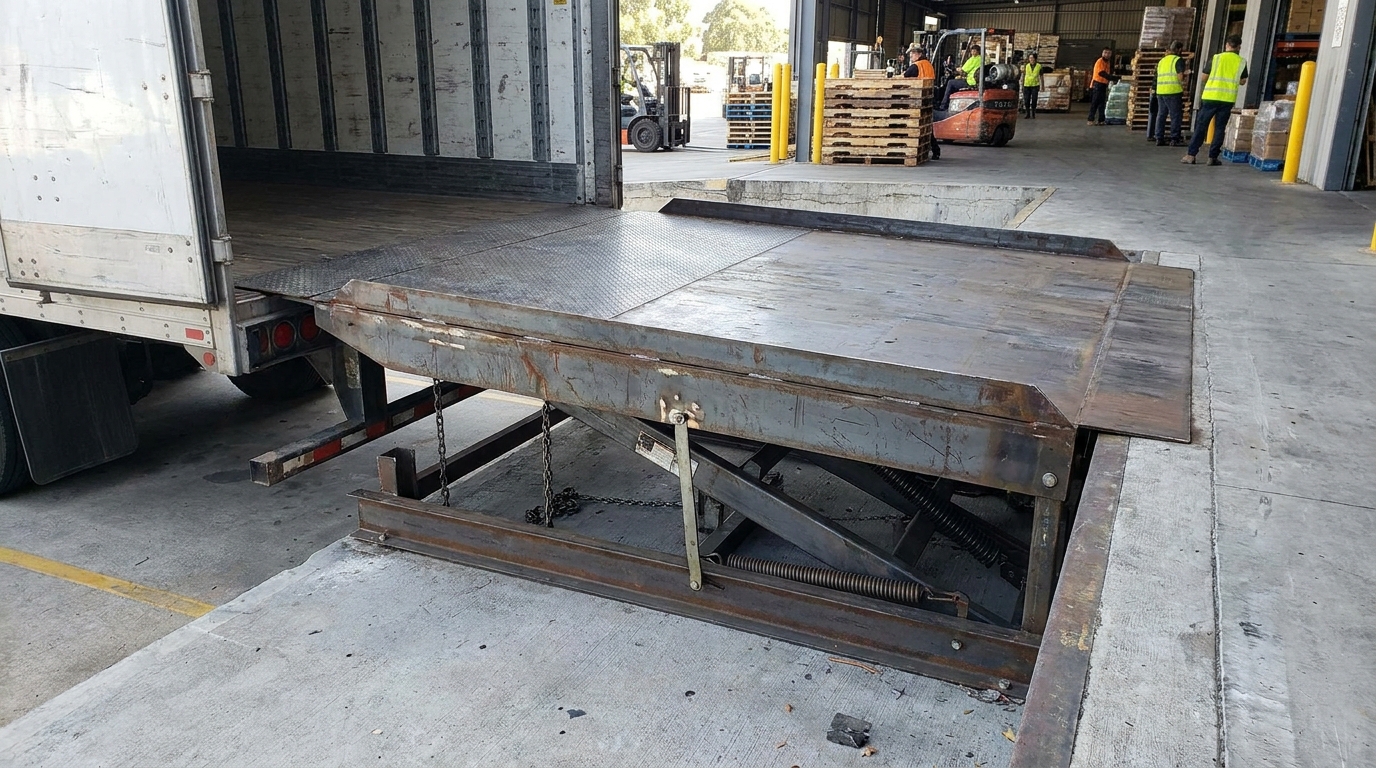
Mechanical dock levelers are essential loading dock equipment that bridge the height gap between a warehouse floor and a truck or trailer bed, allowing forklifts, pallet jacks, and other material handling equipment to move safely and efficiently during loading and unloading.
For warehouse managers, plant engineers, maintenance supervisors, safety managers, and purchasing professionals, understanding how mechanical dock levelers work—and where they fit within a complete loading dock system—is critical for productivity, safety, and long-term cost control. While hydraulic and air-powered dock levelers are popular in many modern facilities, mechanical dock levelers remain a practical, budget-friendly solution for many warehouses, distribution centers, manufacturing plants, and commercial shipping operations.
This guide explains how mechanical dock levelers work, where they are commonly used, their benefits and limitations, safety considerations, maintenance requirements, troubleshooting tips, purchasing factors, and mistakes to avoid.
A mechanical dock leveler is a manually activated loading dock device installed in a pit at the dock door. It uses a spring and linkage system to raise the deck and extend the lip onto the trailer bed. Once positioned, it creates a smooth transition between the dock floor and the truck.
Mechanical dock levelers are typically made from heavy-duty steel and are designed to support the weight of forklifts, palletized loads, and other material handling equipment. They are commonly found in warehouses, manufacturing facilities, food distribution centers, retail distribution operations, and general freight terminals.
Core Components of a Mechanical Dock Leveler
A standard mechanical dock leveler includes several key components:
- Deck plate: The main platform that raises and lowers to match trailer height.
- Lip plate: The hinged front section that extends onto the trailer bed.
- Spring assembly: Provides lifting force when the unit is released.
- Hold-down mechanism: Controls descent and keeps the leveler in position.
- Operating pull chain: Used by the dock worker to activate the leveler.
- Hinge system: Allows movement of the deck and lip.
- Frame and pit structure: Supports the unit within the loading dock pit.
- Toe guards: Help reduce pinch-point hazards along the sides.
These components work together to create a durable, manually operated bridge between the dock and trailer.
Mechanical vs. Hydraulic Dock Levelers
Mechanical dock levelers are often compared to hydraulic dock levelers. The main difference is the method of operation.
| Feature | Mechanical Dock Leveler | Hydraulic Dock Leveler |
||||
| Operation | Manual pull-chain and spring system | Push-button hydraulic operation |
| Power Requirement | No electrical power required | Requires electrical power |
| Upfront Cost | Lower | Higher |
| Maintenance | More mechanical adjustments | Hydraulic system maintenance |
| Ease of Use | Requires physical effort | Easier for operators |
| Best For | Moderate-volume docks | High-volume or heavy-duty docks |
| Safety Options | Basic, with optional upgrades | More integrated safety features |
Mechanical dock levelers can be a smart choice when budget, simplicity, and moderate dock traffic are the primary considerations.
For a deeper understanding of the functionality and benefits of mechanical dock levelers, you may find the article “Mechanical Dock Levelers Explained” particularly insightful. This resource provides a comprehensive overview of how these systems operate and their importance in optimizing loading and unloading processes. To explore this topic further, visit the related article at Mechanical Dock Levelers Explained.
How Mechanical Dock Levelers Work
Mechanical dock levelers operate through stored energy in a spring system. Unlike hydraulic units, they do not require electric motors, hydraulic pumps, or push-button controls.
Step-by-Step Operation
A typical mechanical dock leveler works as follows:
- The operator pulls the release chain.
This disengages the hold-down mechanism and allows the spring system to raise the deck.
- The deck rises upward.
The counterbalance spring assembly assists the deck lift, reducing the force required from the operator.
- The lip extends.
As the deck reaches its full raised position, the lip plate swings outward.
- The operator walks the deck down.
The operator uses body weight or controlled force to lower the deck and lip onto the trailer bed.
- Loading or unloading begins.
Forklifts, pallet jacks, carts, and other equipment travel over the leveler.
- The leveler returns to stored position.
After the truck departs, the leveler is raised again and allowed to return to its dock-level stored position.
Above-Dock and Below-Dock Service
Mechanical dock levelers can typically service trailers slightly above or below dock height. The operating range depends on the specific model, deck length, lip length, and load capacity.
Common working ranges may include:
- Above dock: Approximately 10 to 12 inches
- Below dock: Approximately 10 to 12 inches
However, actual performance varies by manufacturer and installation. Purchasing professionals should confirm the proper operating range before selecting a leveler.
Lip Engagement
Proper lip engagement is one of the most important safety factors. The lip should rest securely on the trailer bed, usually with a minimum recommended engagement of approximately 4 inches, depending on the equipment and application.
Poor lip engagement can lead to:
- Forklift impact
- Trailer creep hazards
- Load instability
- Dock leveler damage
- Operator injury
For safer operations, mechanical dock levelers should be used with appropriate vehicle restraints, wheel chocks, dock bumpers, and clear dock communication procedures.
Common Applications for Mechanical Dock Levelers
Mechanical dock levelers are used across many industries where trucks and trailers are loaded at dock-height doors.
Warehousing and Distribution
In warehouse and distribution facilities, mechanical dock levelers support routine palletized freight movement. They are often used where dock traffic is moderate and loading frequency does not justify the added cost of hydraulic systems.
Common warehouse uses include:
- Pallet loading and unloading
- Forklift traffic
- Less-than-truckload shipments
- Retail replenishment
- General freight handling
Manufacturing Plants
Manufacturing plants often use mechanical dock levelers for inbound raw materials and outbound finished goods. Plant engineers may prefer mechanical units in areas where electrical service is limited or where simple, rugged operation is preferred.
Typical manufacturing applications include:
- Receiving components
- Shipping finished products
- Moving machinery parts
- Loading packaging supplies
- Supporting production logistics
Food, Beverage, and Cold Storage Facilities
Mechanical dock levelers can be used in food and beverage operations, although environmental control must be considered. For temperature-sensitive docks, mechanical levelers may be paired with dock seals, dock shelters, weather seals, or vertical storing levelers in specialized applications.
In cold storage or refrigerated environments, facility managers should evaluate:
- Energy loss around the dock opening
- Cleanability
- Corrosion protection
- Rodent and pest control
- Seal compatibility
Light to Moderate Loading Dock Operations
Mechanical dock levelers are best suited for facilities with moderate usage. High-cycle, multi-shift, heavy-duty environments may benefit from hydraulic dock levelers or other advanced dock equipment.
Mechanical units are commonly selected for:
- Small warehouses
- Commercial buildings
- Municipal facilities
- Regional distribution sites
- Low- to medium-volume dock doors
Please visit this dock equipment guide for more information.
Benefits of Mechanical Dock Levelers
Mechanical dock levelers remain popular because they provide dependable service at a relatively low initial cost.
Lower Upfront Cost
One of the biggest advantages is affordability. Mechanical dock levelers usually cost less than hydraulic or air-powered alternatives. For purchasing professionals managing multiple dock positions, the savings can be significant.
Lower upfront costs make mechanical units attractive for:
- Budget-conscious projects
- Replacement of older units
- Facilities with limited dock traffic
- Expansion projects with many doors
- Backup or secondary dock positions
No Electrical Power Required
Because mechanical dock levelers operate manually, they do not require electrical wiring, motors, or hydraulic pumps. This can reduce installation complexity and avoid electrical infrastructure costs.
This is especially useful in:
- Older buildings
- Remote dock locations
- Facilities with limited power availability
- Outdoor or auxiliary loading areas
Simple and Proven Design
Mechanical dock levelers use a familiar spring-and-linkage system. Maintenance teams often appreciate their straightforward construction because many issues can be visually inspected and mechanically adjusted.
Advantages of the simple design include:
- Fewer powered components
- No hydraulic fluid leaks
- No motor failures
- No electrical controls to troubleshoot
- Long service life with proper maintenance
Good Fit for Moderate Duty Cycles
When properly specified, mechanical dock levelers can provide years of reliable performance in moderate-duty applications. They can handle common forklift loading tasks, palletized freight movement, and general warehouse operations.
Compatibility With Loading Dock Accessories
Mechanical dock levelers can be integrated into a complete loading dock safety system with:
- Dock bumpers
- Dock seals
- Dock shelters
- Vehicle restraints
- Wheel chocks
- Dock lights
- Communication lights
- Safety barriers
- Trailer stands
- Loading dock safety signage
This makes them a flexible option for many facilities.
If you’re looking to enhance your understanding of mechanical dock levelers, you might find it helpful to explore a related article that delves into the various types of loading dock equipment available in the market. This article provides insights into how different systems can improve efficiency and safety in your operations. For more information, you can check out this useful resource on loading dock solutions.
Limitations of Mechanical Dock Levelers
| Feature | Advantages |
|---|---|
| Heavy-duty construction | Durable and long-lasting |
| Easy to operate | Convenient for users |
| Various weight capacities | Can accommodate different loads |
| Low maintenance | Cost-effective in the long run |
While mechanical dock levelers have many advantages, they are not the best choice for every facility.
More Physical Effort Required
Mechanical levelers require operators to pull a chain and walk the deck down. If the spring system is poorly adjusted, the unit can become difficult to operate.
This may create concerns related to:
- Operator fatigue
- Inconsistent use
- Potential strain injuries
- Slower loading cycles
- Reduced productivity at high-volume docks
Facilities with frequent loading activity may prefer push-button hydraulic dock levelers for ergonomic reasons.
More Frequent Mechanical Adjustments
The spring and hold-down systems require periodic inspection and adjustment. Over time, springs can lose tension, linkages can wear, and hold-down mechanisms can become misaligned.
Common adjustment points include:
- Main lift spring tension
- Lip spring tension
- Hold-down ratchet
- Lip extension timing
- Deck balance
Maintenance supervisors should plan routine service to keep the leveler operating smoothly.
Not Ideal for High-Cycle Applications
Mechanical dock levelers can perform well in moderate-use environments, but high-cycle facilities may experience accelerated wear. Distribution centers operating several shifts per day often require powered levelers for better speed, safety, and ergonomics.
Limited Advanced Safety Features
Mechanical levelers typically offer fewer built-in safety features than hydraulic units. For example, hydraulic dock levelers may include automatic return-to-dock functions, constant-pressure controls, and integrated safety systems.
Mechanical units can still be used safely, but they require:
- Proper operator training
- Routine inspections
- Safe work procedures
- Correct trailer restraint practices
- Consistent maintenance
For those looking to enhance their understanding of industrial equipment, a related article on the importance of proper equipment maintenance can provide valuable insights. This article emphasizes how regular upkeep can significantly extend the lifespan of mechanical dock levelers and improve overall efficiency in loading operations. To explore this topic further, you can read more about it in this informative piece.
Mechanical Dock Levelers vs. Dock Plates and Dock Boards
Mechanical dock levelers are sometimes confused with dock plates and dock boards, but they serve different purposes.
Dock Plates
Dock plates are portable metal plates, usually made of aluminum or steel, used to bridge small height gaps. They are typically used with hand trucks, carts, or pallet jacks—not powered forklifts unless specifically rated.
Dock plates are best for:
- Light-duty loading
- Small height differences
- Non-powered equipment
- Occasional use
Dock Boards
Dock boards are heavier-duty portable bridging devices, often with curbs and locking legs. They may be suitable for forklift traffic when properly rated.
Dock boards are commonly used for:
- Temporary loading operations
- Facilities without permanent dock levelers
- Railcar loading
- Uneven dock or trailer conditions
When to Choose a Mechanical Dock Leveler
A mechanical dock leveler is usually the better choice when:
- Loading is frequent enough to justify permanent equipment
- Forklifts are used regularly
- A safer, more stable bridge is needed
- Dock efficiency is important
- The facility has standard dock-height doors
For occasional or low-volume applications, dock plates or dock boards may be sufficient. For consistent warehouse operations, mechanical dock levelers provide a more productive solution.
Safety Considerations and Best Practices
Loading dock safety is a major concern in every facility. The loading dock is one of the highest-risk areas in a warehouse because it involves pedestrians, forklifts, trailers, elevated edges, heavy loads, and moving vehicles.
OSHA Considerations
OSHA does not publish a dedicated standard for dock levelers alone, but several OSHA requirements and general workplace safety principles apply. Employers are responsible for providing a workplace free from recognized hazards under the General Duty Clause.
Relevant OSHA-related considerations may include:
- Forklift operator training under 29 CFR 1910.178
- Walking-working surface safety
- Fall hazard awareness
- Proper use of wheel chocks or vehicle restraints
- Safe trailer loading and unloading procedures
- Equipment inspection and maintenance
- Hazard communication and signage
Facilities should also follow manufacturer instructions and applicable local regulations.
ANSI and Industry Best Practices
ANSI MH30.1 is commonly referenced for loading dock equipment, including dock levelers. It provides guidance on design, performance, installation, inspection, and operation of dock leveling devices.
Best practices include:
- Use dock levelers only within rated capacity.
- Confirm the trailer is properly positioned.
- Ensure the lip is securely supported by the trailer bed.
- Never use a damaged or malfunctioning dock leveler.
- Keep hands, feet, and body parts away from pinch points.
- Do not exceed the leveler’s service range.
- Train operators on proper activation and storage.
- Inspect equipment before use.
- Use vehicle restraints or wheel chocks to help prevent trailer movement.
Vehicle Restraints and Trailer Creep
Trailer creep occurs when a trailer gradually moves away from the dock due to forklift impact and motion. This can create a dangerous gap between the trailer and dock leveler.
To reduce this risk, facilities should use:
- Vehicle restraints: Devices that secure the trailer’s rear impact guard.
- Wheel chocks: Wedges placed at trailer wheels when restraints are not available.
- Dock communication lights: Red/green signals for truck drivers and dock workers.
- Dock bumpers: Protective rubber or laminated bumpers that absorb trailer impact.
Vehicle restraints are strongly recommended for facilities with regular forklift traffic, especially where powered industrial trucks enter trailers.
Dock Bumpers, Dock Seals, and Dock Shelters
Mechanical dock levelers work best as part of a complete dock system.
- Dock bumpers protect the building, dock face, trailer, and leveler from impact damage.
- Dock seals compress against the trailer to help control temperature, weather, dust, and pests.
- Dock shelters provide a more flexible enclosure for varying trailer sizes.
- Dock lights improve visibility inside trailers.
- Safety barriers help prevent falls when dock doors are open.
A safe and efficient loading dock depends on all of these components working together.
Maintenance Requirements for Mechanical Dock Levelers
Proper maintenance helps extend equipment life, improve safety, and prevent unplanned downtime. Mechanical dock levelers should be inspected and serviced regularly based on usage, environment, and manufacturer recommendations.
Daily or Pre-Use Inspection
Operators should visually inspect the dock leveler before use.
Look for:
- Bent or cracked deck plates
- Damaged lip plate
- Loose or missing hinge pins
- Unusual noise during operation
- Debris in the pit
- Broken pull chain
- Worn dock bumpers
- Poor lip engagement
- Damaged toe guards
- Difficulty raising or lowering
If any unsafe condition is found, the leveler should be removed from service until inspected by qualified personnel.
Monthly Maintenance
Maintenance teams should perform more detailed checks monthly or according to facility usage.
Recommended tasks include:
- Clean debris from the pit.
- Inspect springs and linkages.
- Check the hold-down mechanism.
- Lubricate hinges and pivot points as recommended.
- Inspect welds and structural components.
- Test lip extension and retraction.
- Verify proper deck balance.
- Confirm the unit stores flush with the dock floor.
- Inspect dock bumpers and anchoring hardware.
Annual Professional Inspection
At least once per year, or more often for high-use docks, a qualified loading dock technician should inspect the mechanical dock leveler. Professional service can identify wear, misalignment, structural problems, and safety issues before they become major failures.
An annual inspection may include:
- Spring tension adjustment
- Hold-down repair or replacement
- Lip timing adjustment
- Hinge inspection
- Structural weld inspection
- Pit condition assessment
- Capacity label verification
- Safety decal replacement
- Operational testing under normal conditions
Maintenance Table
| Maintenance Task | Recommended Frequency | Responsible Party |
||:||
| Visual inspection | Daily/pre-use | Operator |
| Remove debris from pit | Weekly/monthly | Maintenance |
| Lubricate pivot points | Monthly/quarterly | Maintenance |
| Inspect springs and chains | Monthly | Maintenance |
| Check lip operation | Monthly | Maintenance |
| Inspect dock bumpers | Monthly | Maintenance |
| Professional service | Annually or more often | Qualified technician |
Maintenance frequency should increase in harsh environments, heavy-use docks, cold storage, corrosive operations, or facilities with multiple shifts.
Troubleshooting Common Mechanical Dock Leveler Problems
Mechanical dock levelers are rugged, but they can develop operational issues over time.
Leveler Will Not Raise
Possible causes include:
- Broken or disconnected pull chain
- Weak or broken main spring
- Hold-down mechanism stuck
- Debris blocking deck movement
- Damaged hinge or frame
- Lack of lubrication
Recommended action:
- Remove the unit from service.
- Inspect for obvious obstructions.
- Do not force the leveler.
- Contact qualified maintenance or a loading dock technician.
Leveler Is Hard to Pull or Operate
Possible causes include:
- Spring tension out of adjustment
- Worn linkage
- Corrosion or lack of lubrication
- Damaged hold-down mechanism
- Debris in the pit
This issue should be addressed quickly because difficult operation may lead employees to use unsafe methods or avoid using the leveler correctly.
Lip Does Not Extend Properly
Possible causes include:
- Lip spring failure
- Bent lip plate
- Worn hinge pins
- Incorrect lip timing
- Debris or damage around the hinge
The lip must fully extend and rest securely on the trailer. If it does not, the dock leveler should not be used.
Leveler Drops Too Quickly
Possible causes include:
- Hold-down malfunction
- Worn ratchet mechanism
- Broken linkage
- Improper adjustment
A leveler that drops suddenly is a serious safety hazard. Remove it from service immediately.
Deck Does Not Store Flush
Possible causes include:
- Pit obstruction
- Bent deck or frame
- Worn hinge assembly
- Incorrect adjustment
- Damaged rear hinge
A leveler that does not store flush can create trip hazards and forklift impact issues.
Buying Factors for Mechanical Dock Levelers
Selecting the right mechanical dock leveler requires more than matching a rough size. Purchasing professionals and facility managers should evaluate loading conditions, equipment types, trailer range, safety needs, and life-cycle cost.
Capacity Rating
Capacity is one of the most important specifications. Dock leveler capacity should account for:
- Forklift weight
- Maximum load weight
- Dynamic forces
- Frequency of use
- Speed and impact conditions
- Load distribution
Common rated capacities include:
| Capacity | Typical Application |
|:||
| 25,000 lb | Light-duty pallet handling |
| 30,000 lb | Standard warehouse use |
| 35,000 lb | Moderate forklift traffic |
| 40,000 lb | Heavier loads or higher frequency |
| 45,000+ lb | Heavy-duty industrial applications |
Do not select capacity based only on the heaviest load. The combined weight of forklift and load, plus dynamic impact, must be considered.
Deck Size
Common mechanical dock leveler sizes include:
- 6 ft wide x 6 ft long
- 6 ft wide x 8 ft long
- 7 ft wide x 8 ft long
- 7 ft wide x 10 ft long
Longer levelers provide a more gradual incline, which can be important for:
- Low-clearance forklifts
- Electric pallet jacks
- Tall or unstable loads
- Below-dock service
- Ergonomic handling
Lip Length
Standard lip lengths often range from 16 to 20 inches, though longer lips may be available. The right lip length depends on trailer positioning, dock bumper projection, and required lip engagement.
Pit Dimensions
Mechanical dock levelers are installed in a recessed pit. Before purchasing, confirm:
- Pit width
- Pit length
- Pit depth
- Rear curb angle condition
- Embedded steel condition
- Concrete integrity
- Drainage
- Electrical or conduit conflicts
Replacement levelers must match the existing pit or include appropriate modification plans.
Trailer Types and Height Range
Different facilities serve different vehicles, such as:
- Standard trailers
- Refrigerated trailers
- Flatbeds
- Step vans
- Box trucks
- Container chassis
A mechanical dock leveler must match the range of trailer bed heights served at the dock. If your facility handles many non-standard vehicles, you may need a longer leveler, edge-of-dock leveler, dock board, or specialty solution.
Environment
Consider the operating environment:
- Indoor vs. outdoor exposure
- Washdown requirements
- Cold storage
- Corrosive materials
- Food-grade sanitation needs
- High dust or debris areas
- Coastal humidity
Special coatings, galvanized components, weather seals, and corrosion-resistant options may be appropriate.
Total Cost of Ownership
The lowest initial price is not always the lowest long-term cost. Consider:
- Installation cost
- Maintenance requirements
- Repair frequency
- Operator productivity
- Safety risk
- Expected service life
- Downtime cost
- Replacement parts availability
For some facilities, a hydraulic dock leveler may cost more upfront but offer better life-cycle value. For others, mechanical dock levelers provide the ideal balance of performance and budget.
Common Mistakes to Avoid
Mechanical dock levelers are reliable when properly specified, installed, operated, and maintained. Many problems occur because of preventable mistakes.
Choosing Too Low of a Capacity
Undersizing capacity can lead to cracked welds, bent decks, hinge damage, and unsafe operating conditions. Always consider forklift weight, load weight, dynamic forces, and usage frequency.
Ignoring Dock Bumpers
Worn or missing dock bumpers can allow trailers to strike the dock face, building wall, leveler pit, or dock equipment. This can cause serious structural damage and unsafe lip positioning.
Using a Damaged Leveler
Continuing to use a leveler with a bent lip, broken chain, damaged spring, or malfunctioning hold-down mechanism increases the risk of accidents and expensive repairs.
Poor Operator Training
Even simple equipment requires proper training. Operators should understand how to:
- Activate the leveler
- Confirm trailer position
- Verify lip engagement
- Recognize unsafe conditions
- Store the leveler correctly
- Report maintenance problems
Failing to Control Trailer Movement
Relying only on driver parking brakes is not enough. Trailer creep, early departure, and landing gear collapse are serious hazards. Use vehicle restraints, wheel chocks, communication lights, and written procedures.
Skipping Preventive Maintenance
Many mechanical dock leveler failures can be prevented with routine lubrication, inspection, adjustment, and cleaning. A neglected leveler is harder to operate and more likely to fail unexpectedly.
Mechanical Dock Leveler Safety Checklist
Use this checklist as a starting point for safer loading dock operations:
- Confirm the trailer is properly positioned at the dock.
- Verify dock bumpers are in good condition.
- Secure the trailer with a vehicle restraint or wheel chocks.
- Inspect the leveler before use.
- Pull the release chain using proper body position.
- Ensure the lip fully extends onto the trailer bed.
- Confirm adequate lip engagement.
- Keep hands and feet away from pinch points.
- Do not exceed rated capacity.
- Do not drive over the leveler until it is properly positioned.
- Keep pedestrians clear of forklift traffic.
- Use dock lights when entering trailers.
- Store the leveler properly after use.
- Report defects immediately.
FAQs About Mechanical Dock Levelers
What is the main purpose of a mechanical dock leveler?
A mechanical dock leveler bridges the gap and height difference between a loading dock and a truck or trailer bed. It allows forklifts, pallet jacks, and other material handling equipment to move loads safely and efficiently.
Do mechanical dock levelers require electricity?
No. Mechanical dock levelers operate with a manual pull-chain, spring, and linkage system. They do not require electrical power, which can reduce installation complexity and operating cost.
How long does a mechanical dock leveler last?
With proper specification, installation, operation, and maintenance, a mechanical dock leveler can last many years. Service life depends on usage frequency, load weights, environmental conditions, maintenance quality, and operator practices.
Are mechanical dock levelers safe?
Yes, when properly installed, maintained, and operated within their rated capacity. Safety also depends on trailer restraint, lip engagement, operator training, dock bumpers, visibility, and compliance with manufacturer instructions and applicable OSHA/ANSI best practices.
What capacity mechanical dock leveler do I need?
Capacity depends on forklift weight, maximum load weight, frequency of use, and dynamic impact. Many standard warehouse applications use 30,000- to 40,000-pound capacity levelers, but heavy-duty operations may require higher ratings. A loading dock professional can help determine the correct capacity.
How often should mechanical dock levelers be serviced?
Operators should inspect levelers before use. Maintenance teams should perform periodic inspections and lubrication monthly or quarterly depending on usage. A qualified technician should inspect the equipment at least annually, and more often in high-volume or harsh environments.
What is the difference between a dock leveler and a dock board?
A dock leveler is a permanent pit-mounted or edge-mounted device used at a loading dock. A dock board is a portable plate-like bridge, often used for temporary loading or facilities without permanent levelers. Dock boards must be properly rated for the equipment and loads used.
Can a mechanical dock leveler be used below dock height?
Yes, many mechanical dock levelers can service trailers below dock height within a specified operating range. However, the leveler length, trailer height, forklift clearance, and load stability must be considered.
When should I replace a mechanical dock leveler?
Replacement may be needed if the unit has structural damage, repeated failures, severe corrosion, worn hinges, inadequate capacity, poor ergonomics, or no longer fits your trailer fleet. Frequent repair costs may also indicate that replacement is more economical.
Should I choose mechanical or hydraulic dock levelers?
Choose mechanical dock levelers for lower upfront cost, no electrical requirement, and moderate use. Choose hydraulic dock levelers for high-volume docks, improved ergonomics, push-button operation, and advanced safety features. The best option depends on your facility’s traffic, budget, safety goals, and maintenance capabilities.
Final Thoughts
Mechanical dock levelers are a proven, cost-effective solution for many loading dock applications. They provide a reliable bridge between the dock and trailer, support safe forklift movement, and integrate well with dock bumpers, dock seals, dock shelters, vehicle restraints, dock lights, and other loading dock safety equipment.
However, they must be properly selected, maintained, and operated. Facility teams should consider capacity, deck size, trailer height range, operator ergonomics, maintenance requirements, and long-term safety. Mechanical levelers are not ideal for every application, but in the right environment, they deliver dependable performance and excellent value.
If you are evaluating mechanical dock levelers, replacing aging dock equipment, comparing dock plates and dock boards, or improving overall loading dock safety, MHE Equipment can help. Contact MHE Equipment today for expert guidance, product recommendations, and practical support for your loading dock and material handling equipment needs.
FAQs
What is a mechanical dock leveler?
A mechanical dock leveler is a piece of equipment used to bridge the gap and height difference between a loading dock and a truck or trailer, allowing for the safe and efficient transfer of goods.
How does a mechanical dock leveler work?
A mechanical dock leveler uses a series of springs and hold-downs to raise and lower the platform, allowing it to adjust to the height of the truck or trailer. It is operated manually using a pull chain or other mechanical means.
What are the benefits of using a mechanical dock leveler?
Mechanical dock levelers are known for their durability, low maintenance requirements, and cost-effectiveness. They provide a safe and reliable way to bridge the gap between the loading dock and the truck, improving efficiency and reducing the risk of accidents.
What are the different types of mechanical dock levelers available?
There are several types of mechanical dock levelers, including pit-style, vertical-storing, and edge-of-dock levelers. Each type has its own unique features and benefits, allowing for customization based on specific loading dock needs.
What are some considerations when choosing a mechanical dock leveler?
When choosing a mechanical dock leveler, it’s important to consider factors such as load capacity, platform size, operating mechanism, and overall durability. Additionally, it’s important to ensure that the leveler is compatible with the specific trucks and trailers that will be using the loading dock.